Aluminum Honeycomb Panels vs Aluminum Foam Panels: what differences
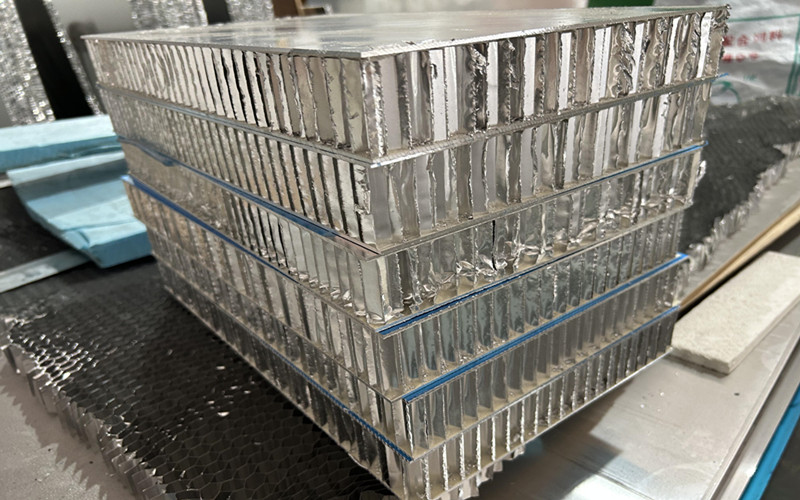
Aluminum honeycomb panels also are called sandwich panels, many people think they and the aluminum foam panels are similar. No, actually they are quite different. Honeycomb panels get their strength from geometry. The hexagonal grid works like a series of I-beams — load is distributed evenly across the structure, delivering exceptional rigidity at very low weight. The design is about structure, not acoustics.
Foam panels get their acoustic performance from disorder. The millions of random pores inside the material act like a sponge for sound waves — energy enters, bounces through the irregular channels, and converts to heat. The design is about absorption, not load-bearing.
Same material family. Completely different engineering logic. They are not interchangeable.
What Is Aluminum Honeycomb Panel?
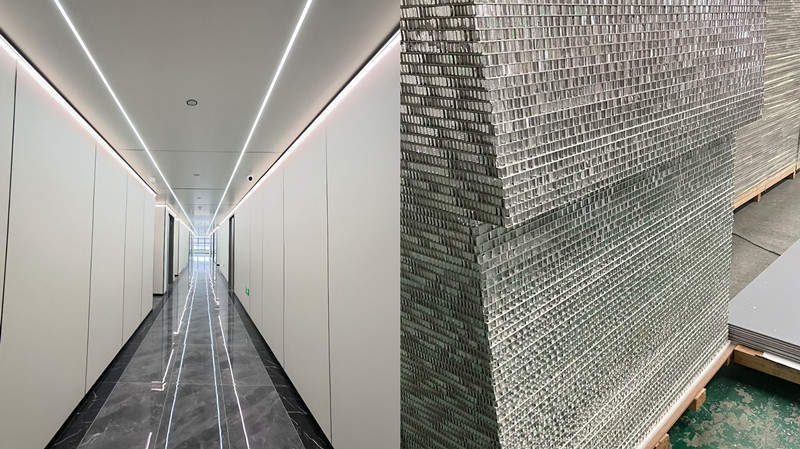
An aluminum honeycomb panel is a three-layer sandwich structure. Two aluminum alloy face sheets — typically 1–2mm thick, in alloys such as 5052, 3003, or 6061 — form the top and bottom skins. Between them sits a honeycomb core made from thin aluminum foil, expanded or folded into a regular hexagonal grid. The face sheets bond to the core through structural adhesive or brazing, creating a single rigid unit.
The core foil is most commonly made from 5052-H19 aluminum, at thicknesses ranging from 0.03 to 0.1mm. The 5052 alloy belongs to the Al-Mg family. It offers higher strength than pure aluminum, good corrosion resistance, and enough ductility to be rolled into very thin foil without cracking — all at a competitive cost. These properties make it the standard choice for honeycomb core production worldwide.
What Is Aluminum Foam Panel?
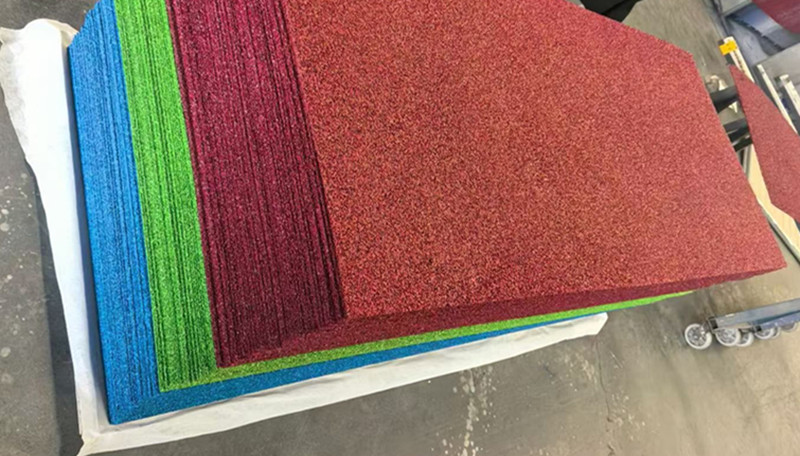
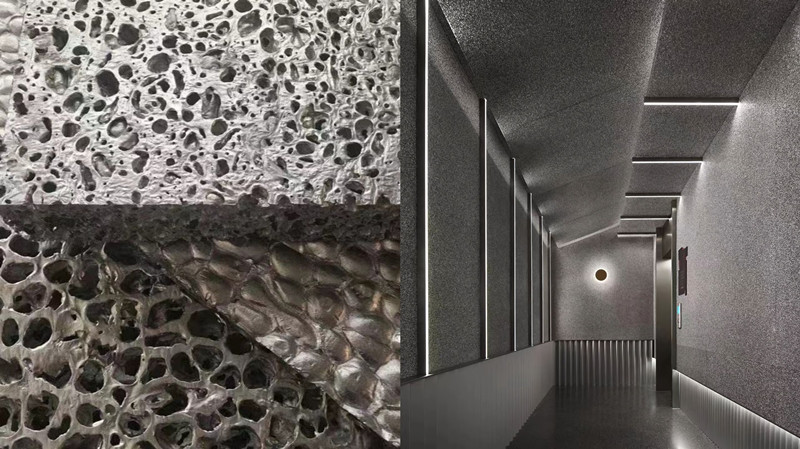
Aluminum foam is a metal material with a large number of small air-filled pores distributed throughout its structure. These pores come in two types. Open-cell foam has interconnected pores that allow air to pass through — similar to a sponge. Closed-cell foam has sealed, isolated pores that trap air inside each cavity. Most aluminum foam panels are available in both types, and the choice depends on the application.
Because of this porous structure, aluminum foam is far lighter than solid aluminum while still retaining meaningful strength and rigidity. Unlike aluminum honeycomb panels, which are built from separate face sheets and a core layer, aluminum foam is a single-piece material with a uniform cellular structure throughout.
This structure gives aluminum foam a unique combination of properties: excellent sound absorption, energy dissipation, vibration damping, and thermal insulation. These qualities make it a practical choice for noise barriers, impact protection components, architectural panels, and transportation safety applications — anywhere a lightweight material needs to do more than just fill space.
AHoneycomb Panels vs Aluminum Foam Panel
| Property | Aluminum Honeycomb Panel | Aluminum Foam Panel |
|---|---|---|
| Structure | Regular hexagonal grid; open interconnected cavities | Randomly distributed pores; open-cell or closed-cell |
| Weight | Very lightweight | Lightweight |
| Strength | Exceptional strength-to-weight ratio; ultra-lightweight | Broadband sound absorption across full frequency range |
| Sound & thermal insulation | Moderate (mid-to-high frequency only); limited absorption | frequency only); limited absorptionOutstanding — 30–40 dB reduction across wide frequency spectrum |
| Manufacturing | Core + face sheets bonded | Foamed molten aluminum or powder |
Application Comparison
| Application Area | Aluminum Honeycomb Panel | Aluminum Foam Panel |
|---|---|---|
| Aerospace | Aircraft panels, flooring | Vibration damping, impact absorption |
| Architecture | Curtain walls, decorative panels | Acoustic panels, insulation |
| Transportation | Train interiors, lightweight panels | Crash energy absorbers |
| Marine & Shipbuilding | Lightweight marine panels | Noise reduction, vibration control |
| Industrial Equipment | Machine covers, equipment housing | Shock absorption, thermal insulation |
Can They Be Used Together?
Aluminum honeycomb panels and aluminum foam panels are not just alternatives to each other — they can work together.
In advanced noise barrier systems, honeycomb panels serve as the outer structural skin. They provide rigidity, weather resistance, and a clean finished surface. Aluminum foam fills the inner layer, handling the acoustic work — absorbing broadband sound and preventing reflection.
This composite approach delivers the best of both materials: the structural efficiency of honeycomb and the acoustic performance of foam. It is already used in high-specification railway and highway projects where both strength and noise control are non-negotiable requirements.
If your project demands serious noise reduction without compromising on structural integrity or longevity, a combined system is worth considering. Contact us to discuss whether this solution fits your application.
How Aluminum Honeycomb Panels Are Manufactured?
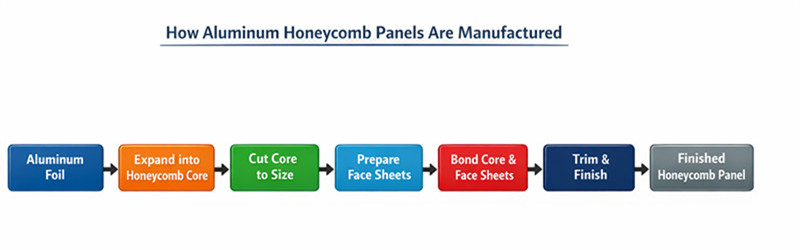
Simple Explaination
Aluminum foil is cut and expanded into a hexagonal honeycomb structure.
The honeycomb core is cut to size.
Prepare the aluminum face sheets.
Bond the honeycomb core and face sheets using high-strength adhesive.
Cure under heat and pressure to form a stable core-face structure.
Trim edges and perform surface finishing to obtain the finished panel.
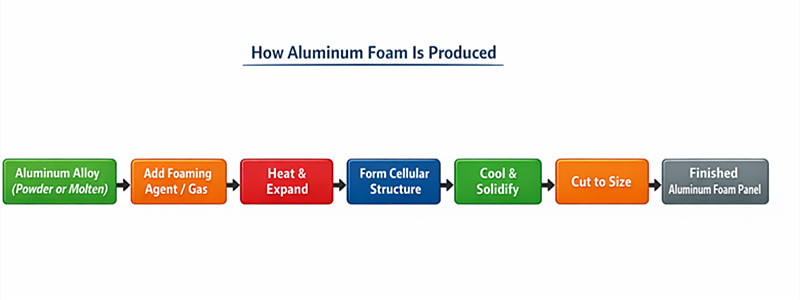
Simple Explaination
Use aluminum alloy powder or molten aluminum as the raw material.
Add a foaming agent or inject gas.
Heat to expand the aluminum and form a porous structure.
Cool and solidify to obtain a rigid metal foam.
Cut into panels or core materials as needed.
How to install aluminum foam and honeycomb sandwich panels?
Foamed Aluminum Panels:
Mechanical fastening with screws, bolts, or clips
Adhesive bonding to surfaces (concrete, metal, gypsum)
Embedded into prefabricated grooves or frames
Honeycomb Aluminum Panels:
Subframe systems with aluminum or steel frames
Hanging systems with hooks or brackets
Hybrid methods combining fasteners and adhesives
Summary:
Aluminum foam: Lightweight, excellent energy absorption, sound and thermal insulation
Aluminum honeycomb panels: High stiffness, load-bearing, flat and strong for structural applications
Frequently Asked Questions (FAQ)
1. How to cut aluminum honeycomb panels?
Aluminum honeycomb panels can be cut using CNC routers, waterjet cutting, or carbide circular saws. Make sure the panel is firmly clamped to prevent deformation of the honeycomb core during cutting.
2. Can aluminum honeycomb panels be machined?
Yes. Machining methods like CNC routing, laser cutting, and edge trimming can create precise shapes or openings while keeping the panel’s structural integrity intact.
3. What is an aluminum honeycomb core vent?
A vented honeycomb core has small perforations in the cells, allowing air or gas to pass through. This improves airflow, heat distribution, and vacuum forming performance in applications such as molds or aerospace tooling.
4. Is aluminum honeycomb recyclable?
Yes. Both the face sheets and honeycomb core are made of aluminum alloys (commonly 3003 or 5052), which can be melted down and reused without losing material properties.
5. Which is lighter — aluminum honeycomb or aluminum foam?
Honeycomb panels win on weight. Their density typically ranges from 3–10 kg/m³ for the core alone, making them one of the lightest structural panels available. Aluminum foam is heavier (200–500 kg/m³) but still far lighter than concrete or steel.
6. Which panel is better for soundproofing?
Aluminum foam panels are the clear winner for noise control. They absorb sound across a broad frequency range and consistently deliver 30–40 dB reduction. Honeycomb panels are good at blocking some mid-to-high frequency sound but do not absorb it — they reflect it back, which can worsen noise on one side.
7. Can aluminum honeycomb panels be used as noise barriers?
They can contribute to noise reduction as part of a composite system, but they are not designed for acoustic performance. If noise control is the primary goal, aluminum foam panels are the right choice.
8. Which panel lasts longer outdoors?
Both handle outdoor conditions well when properly finished. Aluminum naturally resists corrosion. Foam panels have a slight edge in harsh environments (coastal, high humidity) because their solid outer skin offers better sealing against moisture ingress compared to the open edge structure of some honeycomb panels.
9. Which is easier to install?
Honeycomb panels are slightly easier for standard cladding applications — they are thinner, flatter, and easier to cut and fasten. Foam panels are also manageable on-site but are more commonly delivered as finished barrier units rather than raw sheets.
10. Which is more expensive?
Both cost more than concrete or FRP. Honeycomb panels tend to be more cost-competitive for large-area architectural cladding. Aluminum foam panels carry a higher unit price, but their acoustic performance justifies the cost on noise-sensitive projects where no cheaper alternative meets the specification.
11. Are both materials fire-resistant?
Yes. Aluminum is non-combustible and neither panel releases toxic gases in a fire. This makes both materials suitable for tunnels, public buildings, and urban infrastructure where fire safety standards are strict.
12. How do I choose between the two?
Ask one question first: is structural performance or acoustic performance the priority? If you need a strong, lightweight panel for cladding, facades, or interior fit-out — choose honeycomb. If you need to control noise on a highway, railway, or industrial site — choose aluminum foam.