How to Calculate the Weight of Metals by Volume
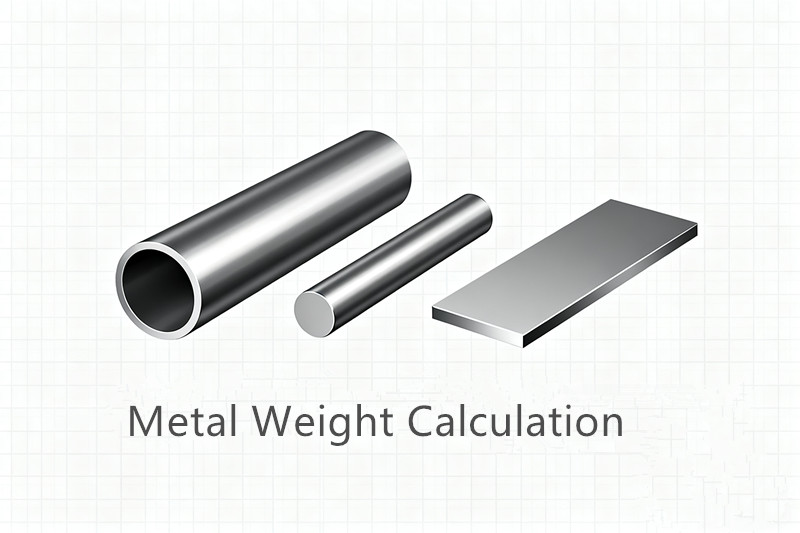
In real work, many people face the same problems: a steel plate is too large to move, and there is no way to put it on a scale.Steel pipes or aluminum tubes are hard to calculate one by one, and even harder to estimate the total weight when shipping in bulk.Aluminum plates or copper bars come in many shapes, and their weight is not easy to judge by eye.For project budgets, transport quotes, or structural calculations, you always need accurate weight data, but often you don't have the chance to weigh the product actually.
In these situations, to calculate by volume is the best way. Knowing the right formula is necessary.
The common volume formula as following:
Let's take aluminum sheet as example:
If all dimensions are in millimeters, the weight of aluminum can be calculated with:
For an aluminum plate: 1000 mm × 500 mm × 2 mm
Volume =
Weight =
the basic principle is Weight (kg)=Volume (m³)×Density (kg/m³), so does other shapes:
Round Bar (Solid Cylinder)
Geometric Volume:
Weight:
Notes:
: diameter (mm)
: length (mm)
: density (g/cm³)
Square Bar (Solid Square Prism)
Volume:
Weight:
Notes:
: side length (mm)
: length (mm)
Round Tube(Hollow Cylinder)
If outer diameterD and inner diameterd are known:
If outer diameterD and wall thickness
Rectangular Tube(Hollow Rectangle/Square Tube)
Outer dimensions:B (width) ×H (height), wall thicknesst, length.
Inner dimensions:B−2t,H−2t.
Volume:
Weight:
Notes:
If it is a square tube, let
Other metals like copper, stainless steel, zinc, for the same shapes, the formula are same, but the different density, copper=8.94, stainless steel=8.00, zinc=7.15, for more easier metal weights calculation, just click and fill in some numbers, then you will get the weight, pls visit my small calculator tool page.