Welded Titanium Tubes vs. Seamless Titanium Tubes: How to Select
If you work in chemical processing, desalination, heat exchangers, or marine engineering, this question probably comes up sooner or later: Should we use welded titanium tube or seamless titanium tube?
After years in the titanium industry, I can tell you this directly:
For most industrial projects, welded titanium tubes are absolutely sufficient — and in many cases, they are actually the more practical and economical option.
Seamless titanium tubes are important too, of course. But they are usually reserved for applications with extremely high pressure, heavy fatigue loads, aerospace standards, or ultra-high-purity systems where specifications leave no room for compromise.
So this article is not about saying one is “better” than the other. It's about helping you choose the one that actually fits your project.
The Real Difference Between Welded and Seamless Titanium Tube
Everything starts from the weld seam.
Welded Titanium Tube
Welded titanium tube is made from titanium strip or titanium sheet. The material is rolled into a tube shape and welded along the longitudinal seam.
The production process is typically:
Titanium strip → Roll forming → Welding → Annealing → NDT inspection
The raw material is usually titanium sheet compliant with ASTM B265.
Many buyers still assume welded tube means “lower quality.” In reality, that's outdated thinking.
A properly manufactured welded titanium tube — with full argon shielding, post-weld heat treatment, and 100% weld inspection — performs extremely well in industrial corrosion environments.
That's exactly why welded titanium tubes are widely used in heat exchangers, condensers, seawater systems, and chemical plants around the world.
Seamless Titanium Tube
Seamless titanium tube starts from a solid titanium billet or titanium bar.
The billet is heated, pierced, rolled, cold-worked, annealed, and processed into a tube without any weld seam at all.
Typical process:
Titanium billet → Piercing → Rolling → Cold working → Annealing → Inspection
The raw material usually follows ASTM B348.
Because there is no weld seam, the tube structure is fully continuous. That gives seamless tubing advantages in high-pressure service, fatigue resistance, and ultra-precision applications.
But it also means higher manufacturing cost and more production limitations — especially on large diameters and long tube lengths.
In Real Projects, How Do We Usually Choose?
Honestly, most projects become much easier once you ask a few simple questions.
1. Does the specification explicitly require seamless tube?
This is the first thing we check with customers.
In aerospace, medical implant systems, or semiconductor ultra-high-purity gas lines, the answer is often already written into the standard.
If the specification says seamless only, then the discussion is over — seamless is mandatory.
2. Is the system under extremely high pressure or cyclic fatigue load?
For example:
High-pressure hydraulic systems
Pulsating pressure pipelines
Aerospace hydraulic tubing
Gas cylinder components
In these cases, seamless tube is usually the safer choice because there is no weld seam and fatigue resistance is naturally better.
3. Is the tube diameter large? Or do you need very long lengths?
This is where welded titanium tube becomes extremely attractive.
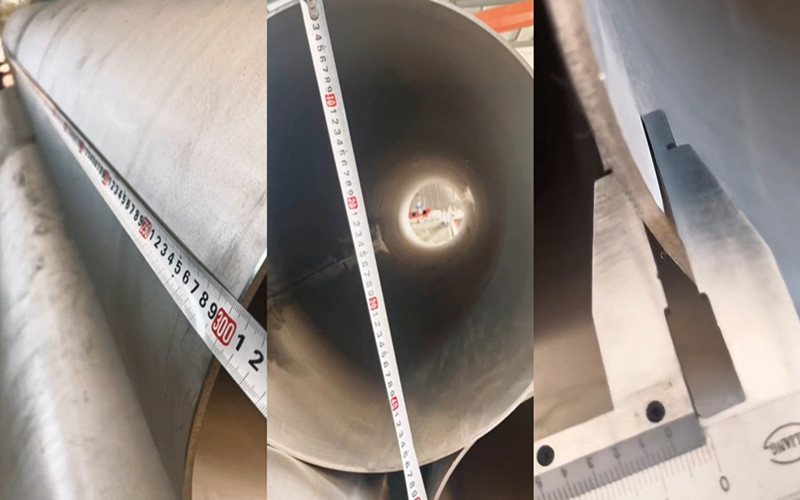
Once the diameter gets large — especially above 400 mm — seamless titanium tube becomes very expensive and difficult to manufacture.
Welded tube, on the other hand, handles large diameter, thin wall, and long continuous lengths much more efficiently.
For seawater desalination and heat exchanger projects, this matters a lot.
4. What is the project really trying to achieve?
In many industrial systems, the key requirement is simply:
Corrosion resistance
Heat transfer efficiency
Stable long-term operation
Reasonable project cost
If that's the case, welded titanium tube is often the best balance.
And to be honest, that's why it has become the mainstream choice in so many industrial applications today.
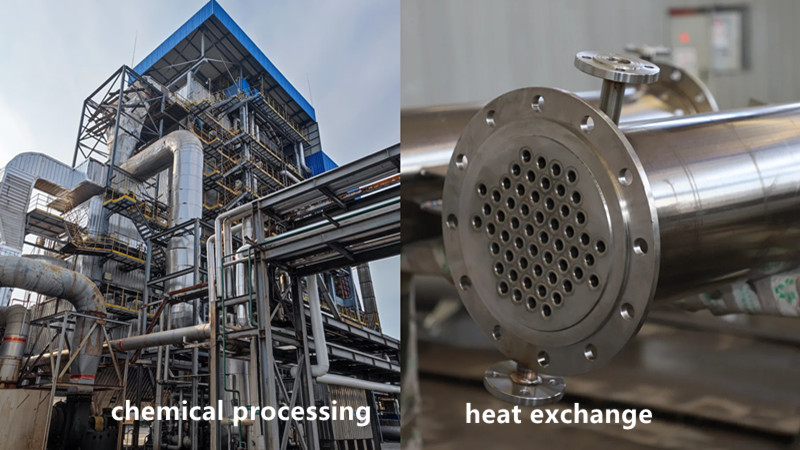
Where Welded Titanium Tube Is Commonly Used
Over the years, most of the welded titanium tube orders we supply go into these industries:
Heat Exchangers and Condensers
This is probably the most common application.
ASTM B338 already allows welded titanium tubes for heat exchangers and condensers, and the industry has decades of successful operating experience behind it.
Customers like welded tube because it offers:
Thin wall capability
Long tube lengths
Lower material cost
Better availability
For large tube bundle projects, the cost savings can be substantial.
Chemical Processing Pipelines
In corrosive media service, titanium itself provides the corrosion resistance.
As long as the welding process is properly controlled, the weld area performs very well too.
For large-diameter chemical piping systems, welded tube is often the most economical solution.
Seawater Desalination and Marine Projects
These projects usually require:
Long continuous tubing
Large quantities
Excellent seawater corrosion resistance
Welded titanium tube fits this perfectly.
In fact, in many desalination projects, welded titanium tube is already considered the industry standard.
Where Seamless Titanium Tube Are Used?
Of course, seamless tubing still has very important applications.
Aerospace and Aviation Systems
This industry leaves very little room for risk.
Fatigue performance, vibration resistance, and structural reliability are critical, so seamless tubing is commonly specified.
Medical and Implant Applications
For implant-grade systems, surface consistency and traceability requirements are extremely strict.
Seamless tubing is preferred for components like:
Catheter tubes
Surgical instruments
Orthopedic devices
Semiconductor Ultra-High-Purity Systems
In semiconductor gas delivery systems, internal surface quality is everything.
Cold-drawn seamless titanium tube can achieve the very high cleanliness and precision standards required in these environments.
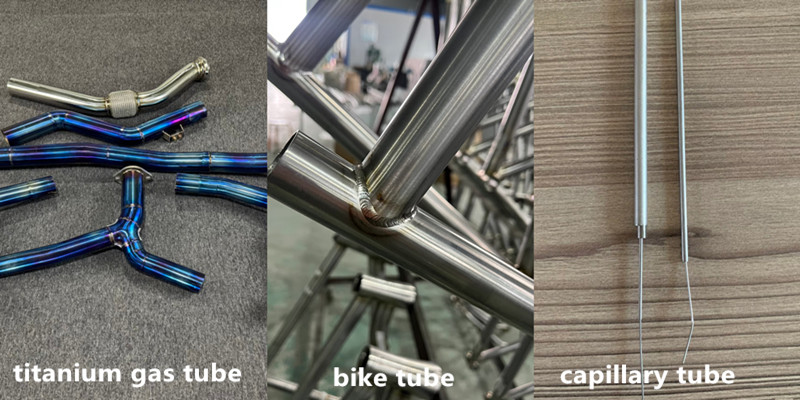
Precision Capillary Tubes
Very small diameters and extremely tight tolerances are still the domain of seamless cold-drawn tubing.
This includes:
Precision instruments
Capillary tubing
High-end bicycle tubing
Specialty engineering applications
One Important Thing Many Buyers Misunderstand
A lot of people worry that the weld seam will automatically become a corrosion weak point.
Actually, in most cases, problems come from poor fabrication quality — not from the existence of the seam itself.
If the manufacturer controls:
Full argon shielding
Proper weld penetration
Post-weld annealing
Non-destructive testing
then the weld area can achieve corrosion resistance very close to the base material.
That’s why choosing the right supplier matters just as much as choosing the right tube type.
What About Cost Difference?
This is usually where customers become very interested.
In general, welded titanium tube is often 20–50% less expensive than seamless tube in the same specification.
Sometimes even more.
The reasons are straightforward:
Titanium strip costs less than titanium billet
Material waste is lower
Production efficiency is higher
Large diameter manufacturing is much easier
As the diameter gets larger and the wall gets thinner, the cost advantage of welded tube becomes even more obvious.
So Which One Should You Choose?
Here's the practical answer I usually give customers:
If your project involves:
Heat exchangers
Chemical processing
Desalination
Marine systems
Cooling water pipelines
Large diameter tubing
then welded titanium tube is very likely the smarter choice.
If your project involves:
Aerospace
Ultra-high pressure
Fatigue-critical systems
Semiconductor gas lines
Medical-grade applications
Ultra-precision tubing
then seamless titanium tube is usually worth the extra cost.
At the end of the day, neither product is universally “better.”
The best choice is simply the one that matches your actual operating conditions, specifications, budget, and long-term reliability goals.
Common Standards Referenced in Titanium Tube Projects
ASTM B338 — Titanium tubes for heat exchangers and condensers
ASTM B862 — Welded titanium tube
ASTM B861 — Seamless titanium tube
ASME SB338 / SB862
EN 10204 3.1 certification
ISO 15614 welding procedure qualification
ISO 9606 welder qualification
If you are currently evaluating titanium tubing for a project and are not sure which option makes more sense, feel free to review our titanium tube specifications here:
Large-diameter High-precision Seamless Titanium Tubes for Marine Aerospace
CP Grade 2 | AMS 4942 | Titanium Seamless Tube
Gr2 Titanium Welded Tubes Coils Customized
Titanium Seamless Tube for Heat Exchanger Condenser