What's the Difference Between Copper T2 vs TU1 vs TU2?
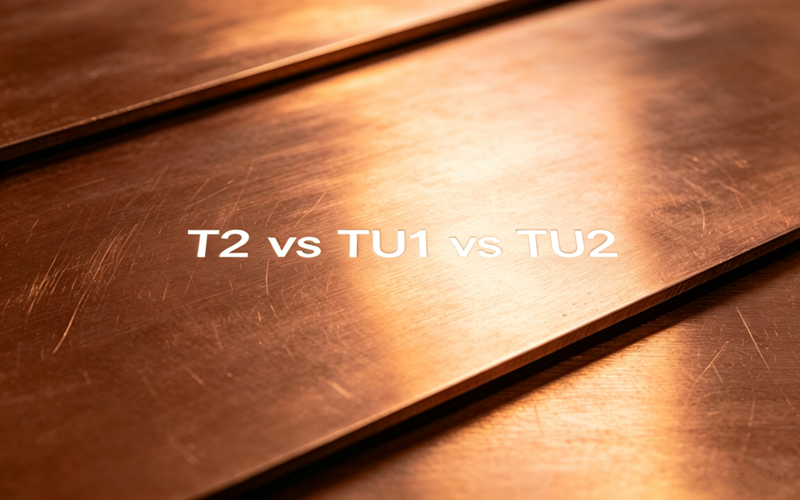
What's the differences between T2, TU1, and TU2 copper, the most basic difference is the oxygen content. TU1 is the highest purity oxygen-free copper, Cu+Ag ≥ 99.97%, O ≤ 0.001%, TU2's purity a little lower, Cu+Ag ≥ 99.95%, O ≤ 0.003%, T2 is high-purity common oxygen-containing copper , tough pitch copper, with copper content ≥ 99.90%.
They also have similarities. All three are wrought pure copper materials. They don't contain specially added alloying elements. T2, TU1, and TU2 all follow the GB/T 5231 national standard system. Their color is reddish-purple, and the density is about 8.9 g/cm³.
We will compare them from several aspects below, to better understand the characteristics and applications of T2, TU1, and TU2.
Equivalent International Grades
T2
ASTM: C11000 (ETP copper)
JIS: C1100
DIN: SE-Cu / CW004A
TU1
ASTM: C10200 (Oxygen-free electronic)
JIS: C1020
DIN: OF-Cu / CW008A
TU2
ASTM: C10200 (often grouped with TU1)
JIS: C1020
DIN: OF-Cu
T2 vs TU1 vs TU2 Composition and Properties
| Category | T2 Pure Copper (Oxygen-bearing) | TU1 Oxygen-Free Copper (Grade 1) | TU2 Oxygen-Free Copper (Grade 2) |
|---|---|---|---|
| Chemical Composition | |||
| Type | Oxygen-bearing copper (tough pitch) | Oxygen-free copper | Oxygen-free copper |
| Min. Cu + Ag Content | ≥ 99.90% | ≥ 99.97% | ≥ 99.95% |
| Oxygen (O) Content | ≤ 0.02% (≤ 200 ppm) | ≤ 0.001% (≤ 10 ppm) | ≤ 0.003% (≤ 30 ppm) |
| Impurity Control | General (limits on Pb, Bi, S, Fe, etc.) | Very strict (extremely low total impurities) | Strict (low impurity levels) |
| Typical Impurities | Trace Pb, Bi, Fe, S, As, etc. | Nearly none (trace levels only) | Small amounts, strictly limited |
| Electrical & Thermal Properties | |||
| Electrical Conductivity (IACS) | ≥ 98% | ≥ 101% | ≥ 100% |
| Thermal Conductivity | Good | Excellent | Very good |
Processing and Safety Comparison
Hydrogen embrittlement risk
T2 has a hydrogen embrittlement risk, while TU1 has no hydrogen embrittlement, and TU2 has no hydrogen embrittlement.
Processing in reducing atmosphere above 370°C
TU1 and TU2 are suitable, but T2 is not suitable for processing or use in a high-temperature (>370°C) reducing atmosphere, because trace amounts of oxygen can easily cause “hydrogen embrittlement".
High-temperature reducing atmosphere
T2 is not applicable, TU1 and TU2 are applicable.
Weldability
T2 is weldable but requires attention to hydrogen embrittlement. TU1 and TU2 are free from hydrogen embrittlement, with excellent weldability.
Cold working plasticity
T2's cold working plasticity is good, while TU1 and TU2 are excellent.
T2 TU1 TU2 Copper Product forms:
T2 copper: plate, strip, foil, tube, bar, wire, and profiles.
TU1 copper: plate, strip, foil, tube, bar, and wire.
TU2 cooper: plate, strip, foil, tube, bar, and wire.
Main Application Differences:
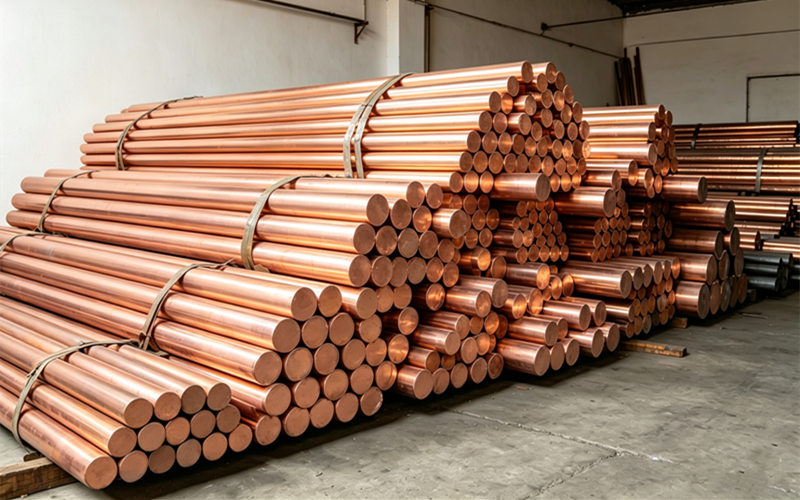
In practical applications, T2, TU1, and TU2 Pure Copper sheets and bars are used for different levels of work. T2 copper is lower price, easy workability, and easy to find. It is used for most common jobs like carrying electricity and heat. TU1 is very pure and with high quality. It is used for special and high-end jobs that need very clean and stable materials.TU2 is in the middle. It has good performance and a fair price. It is widely used in electronics, electrical work, and new energy.
Therefore, these three types cover simple to advanced uses of copper in modern industry.
T2 Copper
Wires and cables, busbars, copper strips, transformer/motor windings
Radiators, heat exchangers, refrigeration tubes
Hardware, rivets, gaskets, architectural decoration
General conductive, thermal, and corrosion-resistant components
TU1 Copper
Vacuum electronic devices (magnetrons, klystrons, microwave tubes)
Semiconductor bonding wires, IC lead frames
5G/millimeter-wave RF cables and waveguides
Aerospace, satellites, superconducting stabilizers
Ultra-high vacuum equipment, laser components
TU2 Copper
Vacuum electronic components, vacuum tubes, X-ray tube parts
High-voltage wiring harnesses for new energy vehicles, battery connectors
Charging connectors, high-frequency cables, waveguides
High-reliability electronics, instrumentation, relays
Welded/high-temperature components sensitive to hydrogen embrittlement
Similarity of T2 TU1 TU2
Besides the differences mentioned above, T2, TU1, and TU2 also share many similarities. In fact, they have a large number of common features. We can look at them from the following aspects:
1. Material Nature
All three are wrought copper. They do not contain intentionally added alloying elements. They all follow the GB/T 5231 national standard system. Their appearance is reddish-purple, and the density is about 8.9 g/cm³.
2. Electrical and Thermal Conductivity
TU1 TU2 and T2 copper are among the best conductive and heat-conductive engineering metals. Their conductivity is much higher than aluminum and steel. The difference is only in degree (98%, 100%, 101% IACS), but the level is essentially the same.
3. Corrosion Resistance
The three copper metals have good corrosion resistance to air, fresh water, seawater, dilute sulfuric acid, dilute hydrochloric acid, acetic acid, and alkaline solutions. This comes from the nature of copper itself, so there is no difference between them.
They are not resistant to concentrated nitric acid, ammonia, and ammonium salt solutions. This weakness is also the same for all three.
4. Workability
T2 TU1 and TU2 have good cold and hot plasticity. They can be drawn, rolled, bent, and stamped. They can be welded and brazed. They are available in forms such as plate, strip, tube, bar, and wire.
5. Low-Temperature Performance
All three maintain good plasticity and impact toughness at low temperatures. They are suitable for low-temperature and cryogenic applications. This is a common advantage of copper compared to many steels.
6. Non-Magnetic Property
All three kinds are non-magnetic materials. They can be used in applications where magnetic interference must be avoided, such as instruments and precision equipment.
FAQ
Is TU1 better than T2 copper?
Yes, TU1 has higher purity and better conductivity, but it is more expensive.
Can TU2 replace TU1?
In many industrial applications, yes. TU2 offers a good balance between cost and performance.