Welding vs Brazing vs Hard Soldering vs Soft Soldering
What is welding?
Welding is a general term for metal joining processes in which two or more materials are permanently joined, usually by the application of heat, pressure, or a combination of both.
In ISO, AWS, and GB standards, welding does not refer to a single method, nor does it only mean melting the base metal. Instead, it is a broad engineering category that includes multiple joining techniques:
Fusion welding – the base metal is melted (e.g. arc welding, laser welding)
Resistance welding – localized melting occurs through electrical resistance
Solid-state welding – the base metal does not melt (e.g. friction welding, diffusion welding)
Therefore, welding ≠ fusion welding only.
Fusion welding is just one type of welding. Some welding processes join materials without melting the base metal at all.
What is brazing?
Brazing is a metal joining process in which two or more metal parts are joined together without melting the base metals.
Instead, a filler metal (called brazing alloy or brazing filler) is heated until it melts and flows into the joint by capillary action, forming a strong, permanent bond after cooling.
Unlike welding in the fusion sense, the base materials remain solid throughout the brazing process. This makes brazing especially suitable for thin-walled components, precise assemblies, and heat-sensitive parts.
In strict engineering classification, brazing is not a type of welding.
It is classified alongside welding under the broader category of joining processes, rather than as a subcategory of welding.
Typical applications of brazing include:
Copper and aluminum tubes
Heat exchangers
Refrigeration and air-conditioning pipelines
Thin-walled metal components requiring clean, leak-tight joints
In short, brazing joins metals by melting the filler metal—not the base metal—using capillary action, which distinguishes it clearly from fusion welding.
What is soldering?
Soldering is a metal joining process in which metal parts are joined using a low-melting filler metal, while the base materials do not melt during the process.
The filler metal, commonly called solder, melts at a temperature below 450 °C and flows into the joint, usually with the help of a flux, to create an electrical or mechanical connection.
Soldering is primarily used where low heat input, precision, or electrical conductivity is required, and where the joint is not subjected to high mechanical loads.
Typical applications of soldering include:
Electronic components and circuit boards
Electrical connections and terminals
Small copper or brass fittings
Fine, heat-sensitive assemblies
In modern engineering standards, soldering is clearly distinguished from brazing by its lower operating temperature.
What was historically called “hard soldering” is now classified as brazing, not soldering.
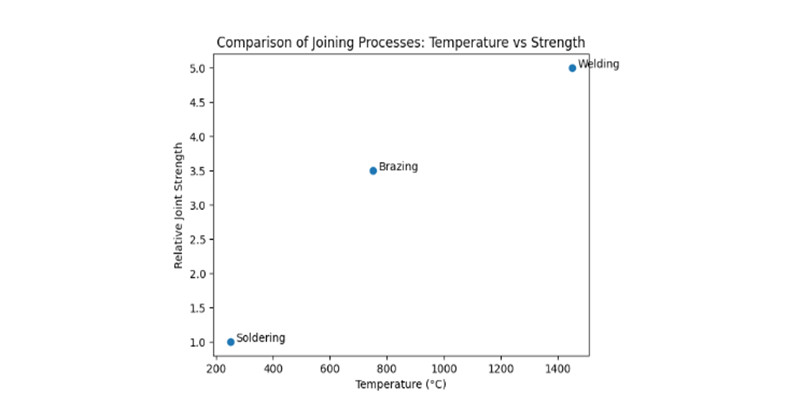
What is the difference between welding, soldering, and brazing?
Welding, soldering, and brazing are all metal joining processes, but they differ fundamentally in how the joint is formed and where they are used.
🔹 Welding
Welding joins metals by melting the base materials themselves, sometimes with the addition of filler metal.
After cooling, the joint becomes part of the base metal, resulting in the highest joint strength.
Base metal melts: Yes
Typical joint strength: High / structural
Common uses: load-bearing structures, pressure vessels, thick plates
🔹 Brazing
Brazing joins metals by melting a filler metal only, while the base materials remain solid.
The molten filler flows into the joint by capillary action, forming a strong and leak-tight bond.
Base metal melts: No
Filler metal melting temperature: Above 450 °C
Typical joint strength: Medium to high
Common uses: copper and aluminum tubes, heat exchangers, refrigeration systems
🔹 Soldering
Soldering is similar to brazing in principle but uses a much lower-temperature filler metal.
The base metals do not melt, and the process is suited for precision and heat-sensitive components, rather than structural strength.
Base metal melts: No
Filler metal melting temperature: Below 450 °C
Typical joint strength: Low
Common uses: electronics, circuit boards, electrical connections
🔹 Key difference summary
| Process | Base metal melted | Filler metal temperature | Joint strength | Typical applications |
|---|---|---|---|---|
| Welding | Yes | Very high | High (structural) | Structural & load-bearing parts |
| Brazing | No | ≥ 450 °C | Medium–high | Tubes, heat exchangers, thin metals |
| Soldering | No | < 450 °C | Low | Electronics, electrical joints |
✅ In simple terms:
Welding melts the base metal
Brazing melts only the filler metal at high temperature
Soldering melts only the filler metal at low temperature
Suitable Joining Methods for Aluminum, Copper, and Titanium Alloys
Aluminum Alloys
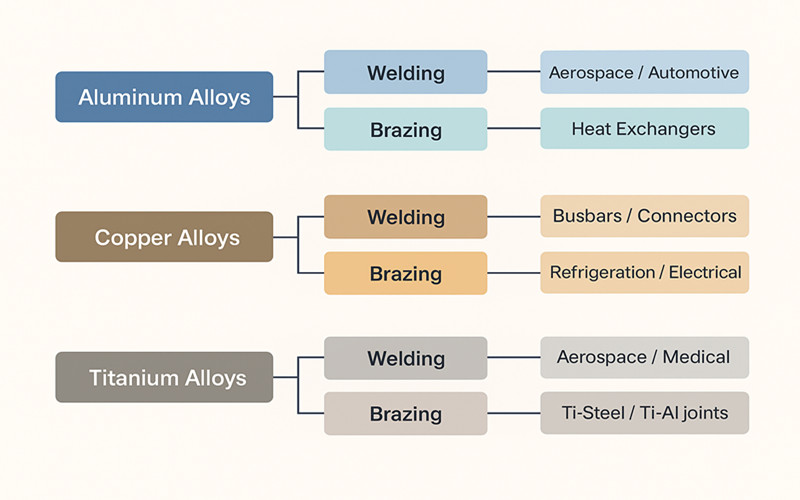
Best methods: MIG/TIG welding, friction stir welding, vacuum brazing
Filler materials: 4043, 5356 welding wire
Applications: Aerospace components, EV battery trays, automotive heat exchangers
Copper Alloys
Best methods: Limited welding (TIG/MIG), silver-based brazing (most common)
Filler materials: Silver-based brazing alloys, phosphorus-copper rods
Applications: Refrigeration and air conditioning copper tubes, electrical busbars, connectors
Titanium Alloys
Best methods: TIG welding, electron beam welding, laser welding (mainstream); vacuum brazing (for dissimilar metals)
Filler materials: Pure titanium wire, Grade 7 wire
Applications: Aircraft engines and fuselages, medical implants, chemical processing equipment
Welding or Brazing? Practical Choices for Each Metal
Aluminum alloys → Both welding and brazing are widely used
Copper alloys → More commonly joined by brazing
Titanium alloys → Mainly joined by welding
Frequently Asked Questions (FAQ)
Q1:What's the difference between soft soldering, hard soldering, welding and brazing?
Soft soldering: Low temperature (below 450°C), mainly for electronics and plumbing.
Hard soldering (silver soldering): Higher temperature than soft soldering, uses silver alloys, stronger joints.
Brazing: Uses filler metal above 450°C but below melting point of base metals; strong, clean joints, often used in HVAC, aerospace, and automotive.
Welding: Base metals are melted and fused together, very strong, used in construction, pipelines, heavy machinery.
Q2: Why is brazing more common for copper alloys?
Copper conducts heat quickly and has a high melting point, making direct welding difficult. Silver-based brazing is more efficient, reliable, and widely used.
Q3: Why are aluminum heat exchangers brazed instead of welded?
Heat exchangers require complex multi-tube structures. Brazing allows mass connections without melting the base material, ensuring high efficiency and airtightness.
Q4: Can titanium alloys be brazed?
Yes, but brazing is mainly used for joining titanium to dissimilar metals (e.g., steel or aluminum). Most titanium components are joined by TIG welding, electron beam welding, or laser welding.
Q5: Is brazing better than soldering?
Yes, brazing is generally stronger than soldering because it uses higher temperatures and stronger filler metals. It’s better for structural or high-stress applications.
Q6: Is soldering as strong as welding?
No. Welding is much stronger than soldering. Soldered joints are not meant for heavy loads, while welded joints can handle structural strength.
Q7:When should soldering be used instead of welding?
Use soldering when you need:
Low heat (electronics, delicate parts)
Easy disassembly or repair
No need for structural strength