What are round aluminum bars used for?

All aluminum round bars may look similar at first glance, basically all in a cylindrical shape—some thin, some thick. But in reality, applications are not determined by shape or size alone; alloy grade, mechanical properties, and manufacturing process all play a much more important role.
For example, 6061 aluminum bar and 7075 aluminum bar may look almost the same externally, but their compositions and performance are quite different. 6061 is an Al-Mg-Si alloy, with good corrosion resistance, weldability, and machinability, widely used in structural parts, frames, general engineering applications, and where moderate strength is enough. 7075, on the other hand, is an Al-Zn-Mg-Cu high-strength alloy, known for its much higher strength and hardness, often used in aerospace components, high-stress mechanical parts, and applications where performance is critical but corrosion resistance and weldability are less prioritized.
Because of these differences, helping customers clearly understand which material is suitable before placing an order is part of our responsibility. We should not just provide “a bar,” but guide them to the right alloy based on their actual working conditions, load requirements, processing method, and cost considerations—so they can avoid mistakes, rework, or unnecessary cost later on.
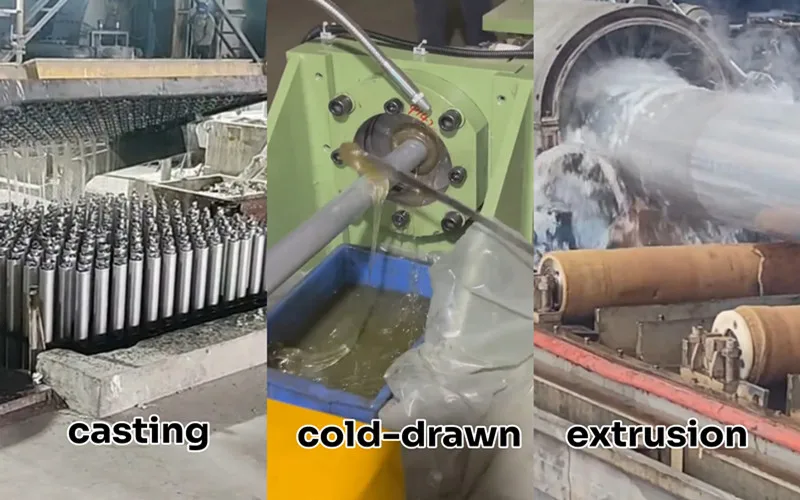
4 Ways to Manufacture Aluminum Round Bars
1. Extrusion (most common)
Heated aluminum billet is forced through a round die
Produces consistent cross-section along the full length
Best for: 6061, 6063, 6082 alloys
Typical size range: 6mm – 300mm diameter
2. Rolling (Hot or Cold)
Hot rolling: billet passed through a series of rollers at high temperature
Cold drawing: hot-rolled bar pulled through a die at room temperature to tighten tolerances and improve surface finish
Best for: 2024, 7075, 5083 alloys (higher strength)
Cold-drawn bars have tighter dimensional tolerance than extruded
3. Forging
Aluminum billet compressed under high pressure into round bar or near-net shape
Produces denser grain structure = higher mechanical strength
Best for: aerospace-grade alloys (2024, 7075, 7050)
Less common for standard commercial bar
4. Casting (Continuous Casting)
Molten aluminum poured into a continuous casting mold
Produces cast rod/bar, often used as feedstock for further processing (drawing, rolling)
Not typically a finished bar product on its own

What are round aluminum bars used for?
1. CNC Machining & Precision Parts
Example: 6061-t6 round bar, 2011-t3 round bar
6061-T6 is the most widely machined aluminum alloy, offering good chip breakage, dimensional stability, and anodizing response. 2011-T3 (free-machining alloy) is chosen when high-volume turning is required. Typical parts include shafts, spindles, connectors, pins, and custom fasteners.
2. Automotive & Transportation
Example: 6061-t6, 6082-t6 aluminum round bar
6061 and 6082 round bars are used for suspension arms, steering components, and structural reinforcements. Both alloys offer a favorable strength-to-weight ratio and are weldable, allowing integration into larger assemblies. Weight reduction at the component level contributes directly to fuel efficiency.
3. Aerospace & High-Strength Structural
Example: 2024-t351 aluminum bar, 7075-t651 aluminum bar
2024 and 7075 are the two dominant aerospace-grade alloys. 7075-T651 offers tensile strength exceeding 500 MPa, making it suitable for aircraft frames, wing spars, and mounting brackets. 2024-T351 is preferred where fatigue resistance is the primary concern. Both are supplied to AMS and ASTM standards.
4. Marine & Corrosion-Resistant Applications
Example: 5083-h112 aluminum round bar, 6061-t6
5083 round bar is selected for marine hardware, shafts, and fittings exposed to seawater. Its magnesium content provides natural corrosion resistance without surface coating. 6061 is used where a combination of corrosion resistance and machinability is needed — boat fittings, railings, and deck hardware.
5. Electrical & Thermal Applications
Example: Aluminum 1350 bar, 6101 round bar
1350 aluminum (99.5% pure) and 6101 are used for electrical bus bars and conductors where high electrical conductivity is the primary requirement. Aluminum's conductivity is approximately 61% of copper IACS but at one-third the weight, making it cost-effective for power distribution systems.
6. Construction & General Engineering
Example: 6063-t6 round bar, 6061-t6
6063 round bar is commonly used for decorative and light structural roles — handrails, support rods, and architectural elements — due to its smooth surface finish after extrusion. 6061 serves heavier structural roles in industrial machinery, frames, and support structures.

FAQ about aluminum round bars
How to calculate the weight of aluminum round bar?
Although aluminum round bars may look simple, their weight is actually determined by a clear formula based on density, diameter, and length. Since aluminum has a relatively stable density (around 2.70 g/cm³ depending on alloy), the main variables are size and length.
In practical use, the weight can be estimated by the formula:
Weight = π × (diameter² ÷ 4) × length × density
Or more simply, customers often use standard conversion tables provided by suppliers, which already take common alloys like 6061 and 7075 into account. This helps avoid calculation errors and saves time during project planning, especially when large quantities are involved.
Understanding weight calculation is not just about numbers—it directly affects shipping cost, machining allowance, and structural design. That's why we always recommend confirming dimensions and alloy grade before estimating total weight.
How to bend aluminum round bar?
Aluminum round bars can be bent, but the process depends heavily on the alloy type, temper condition, and bar diameter. Softer alloys like 6061 in annealed condition (O or T4) are generally easier to bend, while high-strength alloys like 7075 are much less ductile and may crack if bent improperly.
In general, bending is achieved through mechanical bending, heat-assisted forming, or CNC forming methods. For small diameters, cold bending may work, but for thicker bars or harder tempers, pre-heating or controlled forming equipment is often required to avoid surface cracking or internal stress damage.
It is important to understand that not every aluminum round bar is designed for bending. Selecting the correct alloy and temper before processing is essential. This is why we always encourage customers to share their forming requirements in advance, so we can recommend the right material grade and avoid unnecessary processing risk or material failure later in production.

Q: What is the strongest aluminum round bar?
When people ask about the “strongest” aluminum round bar, it usually refers to tensile strength or yield strength—but in reality, there is no single answer, because strength depends on alloy system, heat treatment, and application requirements.
Among commonly used aluminum round bars, 7075 aluminum is widely recognized as one of the strongest standard commercial options. It is an Al-Zn-Mg-Cu alloy, and in T6 temper it can reach very high tensile strength, which is why it is often used in aerospace structures, high-load mechanical parts, and performance-critical components.
Other high-strength options include 7050 and 2024 aluminum, which are also widely used in aerospace and defense-related applications. 7050 offers better stress corrosion resistance compared to 7075, while 2024 provides excellent fatigue resistance. In some specialized cases, ultra-high-strength alloys like 7068 can exceed even 7075 in raw strength, but they are less common and more application-specific.
However, the “strongest” material is not always the best choice. Higher strength often comes with trade-offs such as reduced corrosion resistance, lower weldability, or higher processing difficulty. That’s why material selection should not be based on strength alone, but on a balance of strength, environment, machinability, and cost.
This is also why we always help customers clarify their real working conditions before recommending a material—so they don’t just get the strongest alloy, but the most suitable one for their actual application.