What is nickel-based superalloy?
What Is a Superalloy? A Practical Guide to Nickel-Based Superalloys
When conventional metals like aluminum or carbon steel reach their performance limits under extreme heat, superalloys become the material of choice. Designed to operate where strength, stability, and corrosion resistance are critical, superalloys are essential in aerospace, gas turbines, spacecraft, and other high-temperature systems.
Among all superalloys, nickel-based superalloys dominate high-temperature applications. This article answers the most common engineering questions: What is a superalloy? Why are nickel-based superalloys special? How are they made? Where are they used—and why?
What Is a Superalloy?
A superalloy is a class of high-performance alloy engineered to retain mechanical strength, creep resistance, and chemical stability at temperatures where most metals rapidly degrade.
In practical terms, superalloys are used when materials must withstand:
Sustained temperatures above 600°C
High mechanical stress and centrifugal loads
Severe oxidation and hot corrosion
Long service life with minimal deformation
Unlike standard structural alloys, superalloys are not optimized for low cost or easy processing—they are optimized for survivability in extreme environments.
What Are Nickel-Based Superalloys?
Nickel-based superalloys are superalloys in which nickel forms the primary matrix element. They represent the most widely used superalloy family, especially in aerospace and energy industries.
The reason is simple: nickel maintains a stable crystal structure at very high temperatures, allowing alloy designers to strengthen it through solid-solution strengthening and controlled precipitation.
Typical alloying elements include:
Chromium (Cr) – oxidation and corrosion resistance
Cobalt (Co) – thermal stability and strength retention
Molybdenum (Mo) & Tungsten (W) – solid-solution strengthening
Aluminum (Al) & Titanium (Ti) – formation of the γ′ (Ni₃(Al,Ti)) strengthening phase
This unique microstructure enables nickel-based superalloys to operate near their melting point without catastrophic failure.
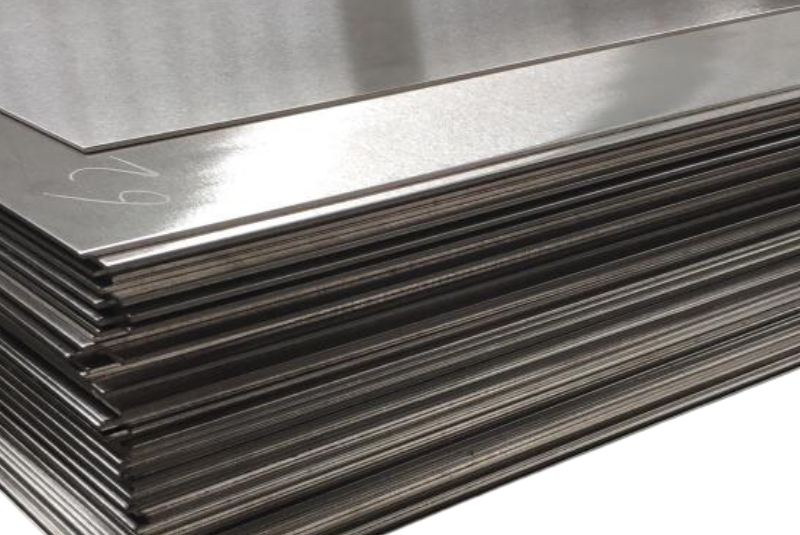
For engineers selecting materials for high-temperature components, a wide range of nickel alloy products—including bars, tubes, plates, and wires—are available depending on processing method and application requirements.
You can explore different forms and grades of nickel alloys used in high-temperature and corrosive environments.
How Are Nickel-Based Superalloys Made?
The performance of nickel-based superalloys depends as much on processing as on chemical composition.
1. Melting and Refining
To achieve extreme purity and compositional control, advanced melting techniques are used:
Vacuum Induction Melting (VIM)
Vacuum Arc Remelting (VAR)
Electroslag Remelting (ESR)
These processes minimize inclusions and segregation, which is critical for fatigue and creep resistance.
2. Solidification Control
Depending on the application, components may be produced as:
Conventional cast alloys
Directionally solidified alloys (grain boundaries aligned with stress)
Single-crystal alloys (no grain boundaries, maximum creep resistance)
Jet engine turbine blades are a classic example where single-crystal nickel-based superalloys are essential.
3. Heat Treatment
Carefully controlled heat treatment develops the γ′ precipitates responsible for high-temperature strength, while stabilizing the microstructure for long-term service.
Key Features of Nickel-Based Superalloys
Exceptional High-Temperature Strength
Nickel-based superalloys maintain useful strength from 600°C up to 1000°C, outperforming aluminum, magnesium, and most steels by a wide margin.
Outstanding Creep Resistance
Under constant stress at high temperature, these alloys resist slow, permanent deformation—making them ideal for turbine discs, blades, and combustion components.
Oxidation and Hot Corrosion Resistance
Protective oxide layers formed by chromium and aluminum additions allow operation in aggressive gas environments.
Microstructural Stability
Even after thousands of hours at elevated temperature, properly processed nickel-based superalloys maintain phase stability and dimensional integrity.
Applications of Nickel-Based Superalloys
Aerospace & Jet Engines
Used in turbine blades, turbine discs, combustion chambers, and exhaust systems where extreme heat and stress coexist.
Industrial Gas Turbines
Critical for hot-section components exposed to continuous high-temperature operation.
Spacecraft and Rocket Systems
Selected for their reliability under thermal cycling, vibration, and vacuum conditions.
Nuclear and Chemical Processing
Ideal for high-temperature, corrosion-intensive environments involving aggressive media.
FAQ: Common Questions About Superalloys
1,Is Inconel a superalloy?
Yes. Inconel is a well-known family of nickel-based superalloys, specifically designed for high-temperature and corrosion-resistant applications.
2,Is aluminum a superalloy?
No. Aluminum alloys offer excellent strength-to-weight ratio, but they lose strength rapidly above ~300°C and lack creep resistance at high temperatures.
3,Is magnesium a superalloy?
No. Magnesium alloys are lightweight but have limited high-temperature capability and poor oxidation resistance compared to superalloys.
4,Is zinc a superalloy?
No. Zinc alloys are used primarily for casting and corrosion protection, not for high-temperature structural applications.
5,How are superalloys machined?
Superalloys are difficult to machine due to high strength and work-hardening. Low cutting speeds, rigid tooling, sharp carbide or ceramic tools, and effective cooling are essential.
6,How are superalloys welded?
Welding requires strict control of heat input and filler selection to prevent cracking and microstructural degradation. Many applications prefer solution-treated or post-weld heat-treated conditions.
7,Why are superalloys used for spacecraft?
Because spacecraft components face extreme temperature swings, high stress, and zero-failure tolerance, superalloys provide unmatched reliability where material failure is not an option.
Final Thoughts
Nickel-based superalloys are not just high-temperature materials—they are engineering solutions for environments where ordinary alloys fail. From jet engines to spacecraft, their unique combination of strength, stability, and corrosion resistance makes them indispensable in modern high-performance systems.