Open Cell and Closed Cell Aluminum Foam Panels
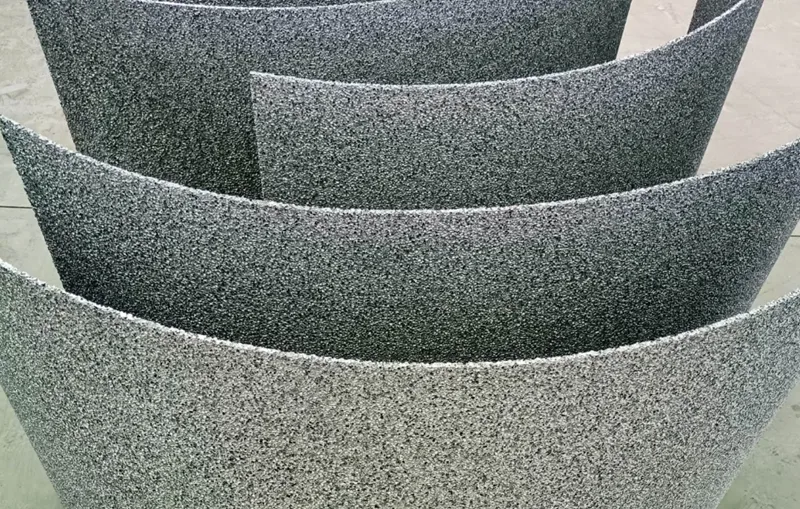
Aluminum foam panels—also known as porous aluminum sheets or plates—are advanced lightweight materials characterized by a unique cellular structure. Unlike traditional aluminum honeycomb panels, aluminum foam is a true porous metal formed by creating gas bubbles within molten aluminum.
Depending on the structure, aluminum foam can be classified into closed cell aluminum foam panels and open cell aluminum foam panels. Closed cell foam features sealed internal pores, providing excellent energy absorption, impact resistance, and structural strength. In contrast, open cell aluminum foam panels have interconnected pores, making them ideal for sound absorption, filtration, and thermal management applications.
Aluminum foam is typically manufactured by injecting gas or adding a foaming agent such as TiH₂ into molten aluminum, then cooling and solidifying the material to trap air within its porous structure. The resulting foam can be processed into panels, plates, or blocks, and may also be combined with aluminum face sheets to form high-performance sandwich structures.
With its combination of low density, mechanical strength, and multifunctional properties, aluminum foam panels are widely used in aerospace, automotive, construction, and acoustic insulation industries—offering a clear advantage over conventional solid or honeycomb aluminum materials.
Sizes of Porous Aluminum Foam Plate
Application Area | Size(mm) | Thickness (mm) |
Highway Sound Barrier | 1000 × 500 | 5 – 100 |
1200 × 600 | ||
1500 × 500 | ||
2000 × 1000 | ||
Acoustic Interior Panels | 1000 × 500 | 5 – 100 |
1200 × 1200 | ||
Architectural Decoration | 1200 × 600 | 10 – 100 |
1200 × 1200 | ||
2400 × 1200 | ||
Composite Panel Material | 1200 × 1200 | 10 – 100 |
2400 × 1200 |
Aluminum Foam Core Panels Types:
Type | Description | Typical Use |
Open-cell | Interconnected pores, breathable, sound-absorbing | Acoustic panels, heat exchangers |
Closed-cell | Sealed pores, stronger, buoyant, water- and air-tight | Structural panels, impact protection |
Key Properties of Aluminum Foam Plate
Property | Performance |
Density | 0.25 – 0.75 g/cm³ (1/5 to 1/10 of solid aluminum) |
Porosity | 70%–90% |
Compressive Strength | 2 – 10 MPa (can be customized) |
Thermal Conductivity | Lower than solid Al (due to air gaps) |
Fire Resistance | Excellent (non-combustible, up to ~600°C) |
Acoustic Absorption | High, especially for open-cell type |
EMI Shielding | Effective (blocks electromagnetic interference) |
Recyclability | 100% aluminum, fully recyclable |
Main Applications of Aluminum Foam Plate:
Acoustic and Noise Control
Aluminum foam wall panels and foam insulated aluminum panels effective in highways and railway walls noise control applications.Architectural and Interior Design
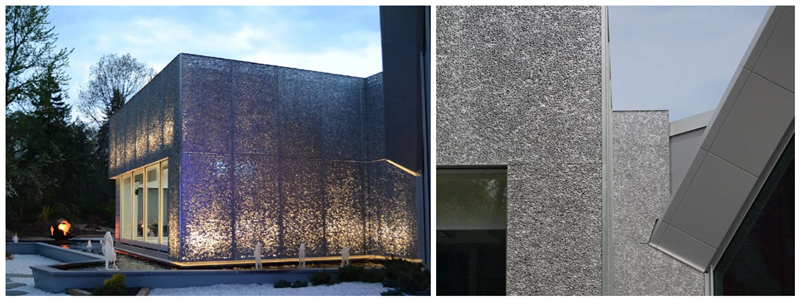
Aluminum foam sandwich panels and aluminum clad foam roof panels suitable for decorative panels, ceilings, and partitions etc. those functional building facades and interior elements.Automotive, Rail, and Aerospace
Used in crash protection, insulation, and structural reinforcement to reduce weight while enhancing safety and energy absorption. Aluminum foam core roof panels contribute to lightweight roofing solutions in these industries.Industrial and Mechanical Use
Serves as heat- and vibration-resistant panels in machines, enclosures, and equipment with high thermal and mechanical stability. Foam aluminum backed panels provide durable protection and insulation for heavy machinery.Military and Fireproofing
Suitable for blast protection, thermal insulation, and fire-resistant paneling, as it withstands high temperatures and absorbs impact energy.Sustainable Construction
Recognized as a recyclable, lightweight material that supports green building initiatives and energy-efficient design.