What is the difference between 6063 t5 and 6063 t6?
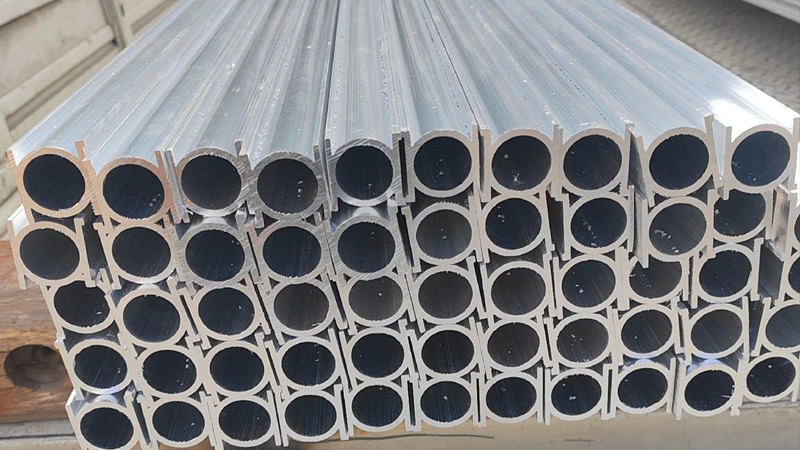
When it comes to aluminum extrusion design, 6063 alloy is one of the most popular choices, widely used in construction profiles, industrial frameworks, and automotive components. Yet one question often arises during material selection: Which I should choose 6063-T5 or 6063-T6?
Although both belong to the same alloy system, their performance and applications differ significantly due to distinct heat treatment processes. This article search from six key aspects — processing, mechanical properties, machinability, corrosion resistance, cost, and applications — to help you make an informed decision.
1. Core difference: the heat treatment route
The main difference between T5 and T6 lies in whether the material has undergone high-temperature solution treatment and rapid quenching.
T5 temper: The extrusion cools naturally, followed by artificial aging to allow partial precipitation strengthening.
T6 temper: The extrusion is solution treated at 520–540°C to dissolve Mg₂Si, water-quenched to form a supersaturated solid solution, and then artificially aged to reach peak strength.
Simply put, T5 uses residual heat from extrusion, while T6 goes through a full heat treatment cycle to maximize strength. As a result, T6 achieves higher strength and hardness, while T5 offers better formability and faster production.
2. Mechanical properties: strength vs ductility
T6 is typically 20–25% stronger than T5, with tensile strength above 215 MPa and yield strength around 180 MPa. T5 generally reaches 175 MPa and 145 MPa respectively.
However, this comes with lower ductility — elongation drops from around 8% (T5) to 5% (T6). In practical terms, T6 is stronger but less flexible, while T5 is easier to bend and form.
If your design prioritizes load-bearing and deformation resistance (frames, brackets, vehicle supports), choose T6. If your part needs bending, punching, or forming (doors, decorative profiles, railings), T5 is more suitable.
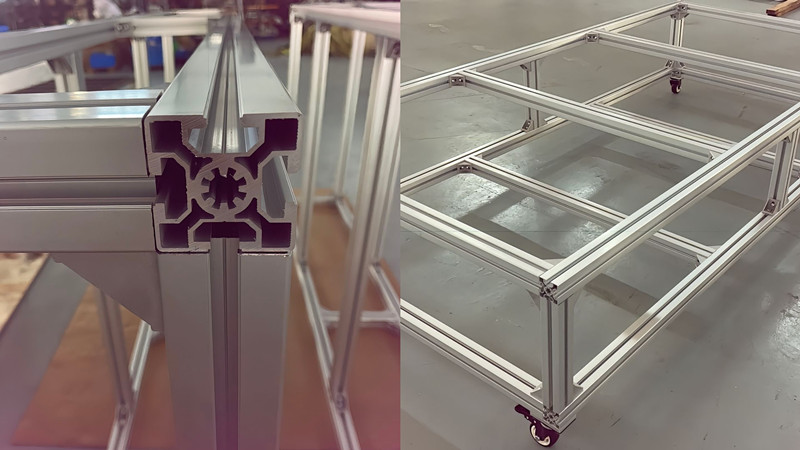
3. Machinability and forming performance
Processing behavior often determines real production efficiency.
Bending & Forming: T5 handles larger bending angles without cracking; T6 requires larger radii due to higher hardness.
Cutting & Milling: T6 performs better in precision machining with smoother surfaces; T5 may cause tool adhesion (“built-up edge”).
Welding: T5 welds more stably with smaller strength loss; T6 requires tighter control to prevent over-aging.
So, for components requiring post-forming, T5 is more forgiving; for CNC-machined parts, T6 provides better dimensional stability.
4. Corrosion resistance
Both belong to the Al-Mg-Si system with naturally good corrosion resistance. The main difference lies in internal stress:
T5, cooled naturally, carries lower residual stress and performs well in humid or marine conditions;
T6, after quenching, may develop higher internal stress, increasing the risk of stress corrosion unless stress relief or anodizing is applied.
5. Cost and lead Time
T5 production is simpler — no high-temperature solution or quenching steps, resulting in lower energy use and shorter cycles (1–2 days).
T6 requires additional furnace time and quenching systems, extending production to 3–5 days and increasing cost by roughly 10–15%.
For high-volume, cost-sensitive applications, T5 is more economical; for high-performance structural components, T6 is worth the investment.
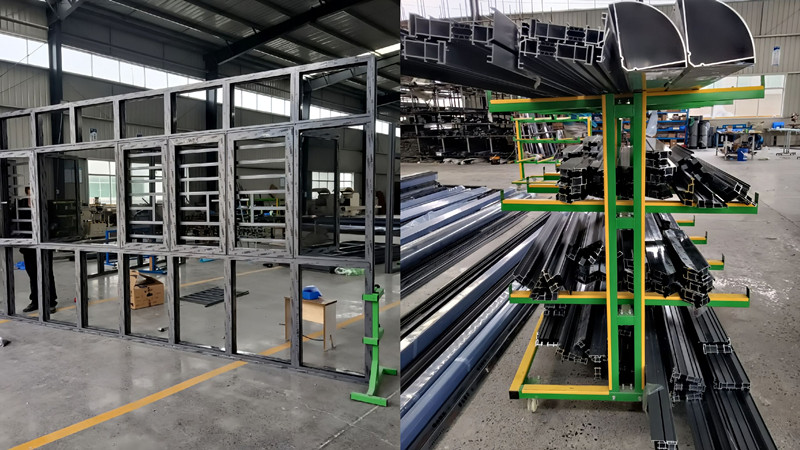
6. Application Guide
6063-T5: ideal for architectural and decorative profiles, furniture frames, or non-load-bearing parts.
6063-T6: preferred for load-bearing frames, automotive fittings, mechanical brackets, and precision machined parts.
Quick rule of thumb:
Prioritize formability and cost → T5
Prioritize strength and precision machining → T6
Humid or coastal environment → T5 or stress-relieved T6
Heavy-duty structures → T6
7. Conclusion
Both T5 and T6 have their strengths — the right choice depends on your balance between strength, formability, environment, and cost.
If you're evaluating which temper best fits your design, explore our available 6063-T5 and 6063-T6 extrusions, complete with thickness, tolerance, and MOQ details.
View 6063-T5/T6 Aluminum Extrusion Specification. Our team can also provide technical recommendations or samples based on your drawings and application requirements.