Cold Finished Drawn Aluminum bar rod 6063 T6
What is cold finished aluminum?
Cold-finished aluminum alloys are products formed at or near room temperature through processes such as cold rolling, cold extrusion, and cold drawing. The core principle is shaping and strengthening the material by external force without heating it to the recrystallization temperature (150–300°C). Through the work-hardening effect, these alloys achieve increased strength and hardness, along with excellent surface finish and dimensional precision (tolerance up to ±0.01 mm), distinguishing them from hot-worked products that typically have lower strength and rougher surfaces. However, cold finishing can make the material brittle, so intermediate annealing is often required to relieve internal stress and restore ductility.
Because of their high precision and superior mechanical properties, cold-finished aluminum alloys are widely used in aerospace (aircraft skins), electronics (lithium battery casings), consumer products (smartphone frames), and automotive applications (lightweight structural components). They represent a key category of aluminum alloys that balance form and performance.
What is 6063 t6 aluminum?
6063-T6 is originally a product of hot working (such as hot extrusion) combined with heat treatment. When it undergoes additional cold finishing (such as cold rolling, cold drawing, or straightening), the following major changes occur based on its original T6 condition:
(1) 6063 t6 mechanical properties
Cold finishing introduces a work-hardening effect, causing grain slip, deformation, and dislocation accumulation within the alloy. This further enhances tensile strength, yield strength, and hardness (for instance, tensile strength increases from about 210 MPa in T6 to 230–250 MPa after cold working). However, this process consumes the alloy's ductility, reducing elongation (from about 10% in T6 to 5%–8%) and making the material more brittle—thus more prone to fracture under stress.
(2) Cold finished aluminum bar tolerances
Cold finishing processes (such as cold drawing or cold rolling) allow for precise dimensional control and tighter tolerances—for example, straightness tolerance can improve from ±1 mm/m (hot worked) to ±0.5 mm/m, and sheet thickness tolerance can narrow from ±0.1 mm to ±0.03 mm. Since cold finishing occurs at room temperature, it avoids oxidation and can remove light oxide scales that may remain on T6 surfaces. The result is an improved surface roughness value (Ra) from 1.6 μm to below 0.8 μm, reducing the need for further polishing.
(3) Internal Structure
Cold finishing disturbs the stable microstructure established during T6 treatment, where Mg₂Si precipitates are evenly distributed within uniform grains. Plastic deformation during cold work generates residual stresses, particularly near edges or complex cross-sections, which may cause distortion during subsequent machining (such as cutting or drilling). In addition, original equiaxed grains elongate along the processing direction, forming a fibrous grain structure. This leads to anisotropy, meaning that strength is higher along the processing direction than perpendicular to it.
(4) Post-Processing Requirement
Due to the internal stresses and reduced ductility introduced by cold finishing, low-temperature stress-relief annealing (around 100–150°C, below the T6 aging temperature) is often applied. This treatment can remove over 80% of residual stress, preventing deformation or cracking during service, while slightly restoring ductility (elongation increasing from about 5%–8% to 7%–9%). Importantly, this process does not significantly reduce the enhanced strength gained from cold finishing, achieving a balanced improvement in strength and stability.
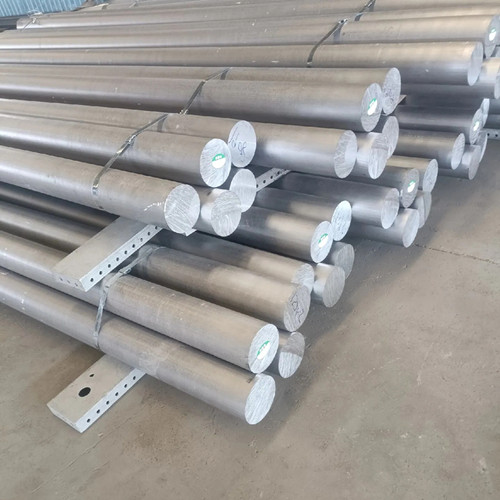
Stock list of Cold finished (drawn) Aluminum rod bar 6063 T6
Available shapes: Flats, squares and rounds
Tempers: T6, T651, T6511
Specifications: ASTM B221, AMS 4156, AMS QQ-A-200/9
Alloy | Temper | Dia.(mm) | Length(mm) |
6063 | T6 | φ5 | 2500/3000 |
6063 | T6 | 5.5 | 2500/3000 |
6063 | T6 | φ6 | 2500/3000 |
6063 | T6 | 6.5 | 2500/3000 |
6063 | T6 | φ7 | 2500/3000 |
6063 | T6 | 7.5 | 2500/3000 |
6063 | T6 | φ8 | 2500/3000 |
6063 | T6 | 8.5 | 2500/3000 |
6063 | T6 | φ9 | 2500/3000 |
6063 | T6 | φ10 | 2500/3000 |
6063 | T6 | 10.5 | 2500/3000 |
6063 | T6 | φ11 | 2500/3000 |
6063 | T6 | 11.5 | 2500/3000 |
6063 | T6 | φ12 | 2500/3000 |
6063 | T6 | 12.5 | 2500/3000 |
6063 | T6 | φ13 | 2500/3000 |
6063 | T6 | 13.5 | 2500/3000 |
6063 | T6 | φ14 | 2500/3000 |
6063 | T6 | φ15 | 2500/3000 |
6063 | T6 | 15.5 | 2500/3000 |
6063 | T6 | φ16 | 2500/3000 |
6063 | T6 | φ17 | 2500/3000 |
6063 | T6 | φ18 | 2500/3000 |
6063 | T6 | φ19 | 2500/3000 |
6063 | T6 | φ20 | 2500/3000 |
6063 | T6 | φ21 | 2500/3000 |
6063 | T6 | φ22 | 2500/3000 |
6063 | T6 | φ23 | 2500/3000 |
6063 | T6 | φ24 | 2500/3000 |
6063 | T6 | φ25 | 2500/3000 |
6063 | T6 | φ26 | 2500/3000 |
6063 | T6 | φ27 | 2500/3000 |
6063 | T6 | φ28 | 2500/3000 |
6063 | T6 | φ29 | 2500/3000 |
6063 | T6 | φ30 | 2500/3000 |
Why buy cold finish aluminum?
When purchasing cold-finished aluminum alloys, the main advantage is their ability to meet the high-precision, high-strength, and superior surface requirements that hot-worked alloys cannot. Processed at room temperature, they gain work hardening, giving higher strength and hardness without additional heat treatment. Dimensional tolerance can reach ±0.01 mm, suitable for precision parts in electronics and aerospace. With no high-temperature oxidation, they offer a smooth surface (Ra ≤ 0.8 μm) and reduced surface finishing. Cold finishing also enables forming complex, fine shapes for heat sinks and precision instruments, combining performance and practicality.
Can I bend 6063 t6?
Yes, 6063-T6 aluminum can be bent, but its high-strength T6 temper limits formability. Because it is heat-treated for strength, it becomes harder and less ductile than annealed aluminum, making it more prone to cracking during forming. To minimize risk, use slow, controlled bending methods such as press braking, and apply a large bend radius—typically 3–5 times the material thickness—to reduce stress.
Pre-heating the material to 200–300°F (93–149°C) can temporarily improve ductility, though it may slightly lower T6-level strength. Thinner gauges (below 0.125 in) are generally easier to bend than thicker sections. Keep in mind that bending introduces residual stresses, and repeated bending may lead to fatigue failure. For parts requiring more complex forming, it's better to start with 6063-T4, perform the bending, and then heat-treat to T6 afterward for optimal strength and finish.