Aluminum 6061 t6 vs 7075: weight, strength and machining
Among the many grades of aluminum alloys, 6061-T6 and 7075 stand out as two of the most widely used and representative materials in modern engineering. Both share the general advantages of aluminum — lightweight, corrosion resistance, excellent formability, and a high strength-to-weight ratio — yet each possesses its own unique strengths and disadvantages
While 6061-T6 is known for its outstanding machinability, weldability, and balanced mechanical performance, 7075 offers exceptional hardness and tensile strength, often rivaling that of steel. These differences make them suitable for very different applications: one for general structural and industrial use, and the other for high-stress aerospace and defense components.
This article focuses on a detailed comparison between 6061-T6 and 7075 aluminum alloys in terms of weight, strength, and application suitability. By understanding the fundamental differences in composition and performance, engineers, designers, and buyers can make more informed decisions when selecting the right alloy for their specific projects — achieving the optimal balance between performance, cost, and reliability.
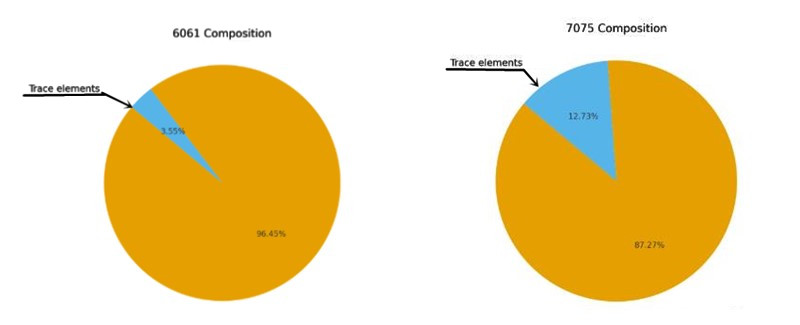
1. 6061 t6 vs 7075 composition
6061 aluminum alloy (Al–Mg–Si Series)
6061 is primarily alloyed with magnesium (0.8–1.2%) and silicon (0.4–0.8%). These elements form the strengthening compound Mg₂Si, which significantly enhances mechanical strength after heat treatment.
Minor additions of copper (0.15–0.4%) improve strength without majorly affecting corrosion resistance, while chromium (0.04–0.35%) and manganese neutralize impurities and enhance corrosion resistance. Titanium (≤0.15%) refines the grain structure. With over 98% aluminum content, 6061 offers an excellent balance of strength, corrosion resistance, and machinability — a classic all-purpose alloy.
7075 aluminum alloy (Al–Zn–Mg–Cu Series)
7075's key alloying elements are zinc (5.1–6.1%), magnesium (2.1–2.9%), and copper (1.2–2.0%). These elements act synergistically to produce exceptional hardness and tensile strength.
Small additions of chromium (≤0.28%) reduce grain-boundary corrosion, while titanium and manganese further refine the microstructure. This alloy’s dense, precipitate-hardened structure makes 7075 one of the highest-strength aluminum alloys available.
2. 6061 t6 vs 7075 weight and density
Theoretical density of 6061 is 2.70 g/cm³, slightly lower than 7075 at 2.80 g/cm³.
For equal volumes, 7075 parts are about 3–4% heavier. For instance, a 100 cm³ component weighs roughly 270 g in 6061 versus 280 g in 7075. While minor per part, this difference accumulates in weight-critical applications like aircraft or EVs, where every gram matters.
3. 6061 t6 vs 7075 strength
6061-t6 aluminum
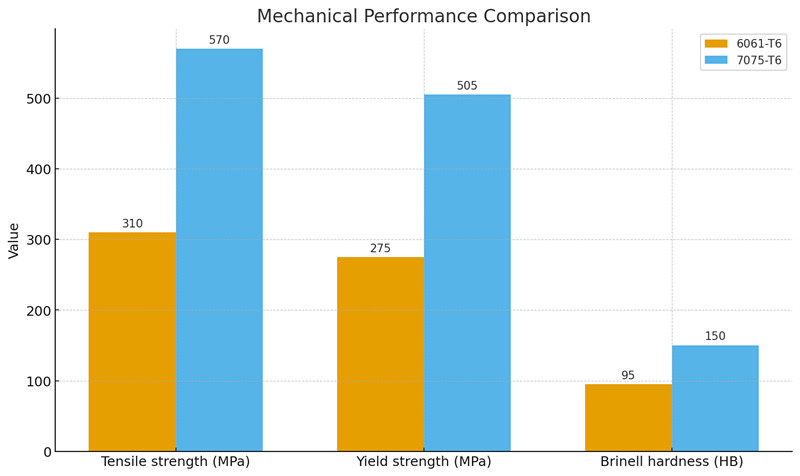
In T6 temper, 6061 exhibits a tensile strength of ≈310 MPa and yield strength of 240–276 MPa, with elongation of 8–12%. This provides good ductility and energy absorption under load. It is ideal for medium-duty structural parts such as car frames, window structures, and electronic housings.
7075-t6 aluminum
Known as the“powerhouse”among aluminum alloys, 7075-T6 offers tensile strength of 524–572 MPa and yield strength of 455–503 MPa, about double that of 6061. Its superior fatigue and impact resistance make it the material of choice for highly stressed aerospace and defense components — such as aircraft spars, landing gear, and armored vehicle structures — as well as high-end sports equipment like performance bike frames.
4. 6061 t6 vs 7075 disadvantages
6061 aluminum alloy
Lower strength than 7075; unsuitable for extremely high-load components.
Strength loss after welding, requiring post-weld heat treatment.
Limited use in ultra-high-stress applications (e.g., bridge main beams, primary aerospace structures).
7075 aluminum alloy
Difficult to machine due to high hardness, leading to faster tool wear.
Poor weldability — prone to cracks and porosity during welding.
Lower corrosion resistance, especially in marine or humid environments; requires surface treatments like anodizing or coating.
Reduced formability, making it unsuitable for complex shapes.
5. Applications comparison

6061 Aluminum Alloy Applications
6061 aluminum alloy is one of the most versatile and widely used aluminum grades. Thanks to its excellent strength-to-weight ratio, corrosion resistance, and good weldability, it is ideal for transportation and structural applications.
In the aerospace industry, 6061 aluminum is used for aircraft structures, wing ribs, and fuselage components. In the railway sector, it is applied to train body panels, frames, and interior structures to achieve lightweight and high durability. For marine use, 6061 aluminum sheet and plate are used in boat hulls, ship decks, and offshore equipment, offering excellent resistance to seawater corrosion. In bicycles and automotive parts, 6061 aluminum tube is favored for bike frames, wheels, motorcycle parts, and car chassis components, combining high performance with reduced weight.
7075 Aluminum Alloy Applications
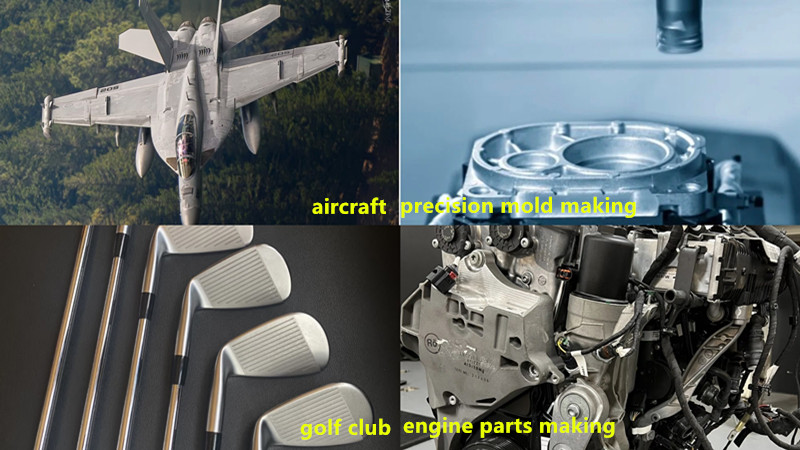
7075 aluminum alloy is a high-strength, aerospace-grade material known for its superior hardness, fatigue resistance, and machinability. It is commonly used in military and defense applications, especially in armed aircraft structures, landing gear, and missile components where extreme strength is required. In precision machining and mold making, 7075 aluminum plate and block are ideal for CNC machined parts, molds, and tooling plates. The alloy is also widely used in sports and performance equipment such as golf club heads, bicycle components, and racing parts for its excellent stiffness and light weight. Additionally, 7075 aluminum is found in engine parts, valve bodies, and aerospace fittings that demand high strength and fatigue performance.
7075-T6 vs 6061-T6 Machining
On paper, 7075-T6 is significantly stronger and harder than 6061-T6, leading many engineers to assume it must also be much more difficult to machine. In practice, however, that isn't always the case.
Based on feedback from customers machining aerospace components, molds, and high-strength structural parts, many experienced CNC operators report that 7075-T6 often machines just as smoothly as 6061-T6—and in some situations, even better.
The biggest difference comes from chip formation.
Because 6061 is a relatively soft aluminum alloy, it can occasionally produce long, stringy chips and has a greater tendency to adhere to cutting edges during aggressive machining. Under certain cutting conditions, this may lead to built-up edge (BUE), reduced surface finish, or chip evacuation problems.
7075-T6 behaves differently. Its higher strength allows chips to fracture more readily, resulting in cleaner chip evacuation and less material welding onto the tool. During high-efficiency roughing operations, many machinists find that 7075 produces a more consistent cutting action with fewer interruptions caused by chip packing.
For shops already running optimized toolpaths such as adaptive clearing or dynamic milling, cutting speeds often require little adjustment when switching from 6061 to 7075. In many cases, spindle speed remains similar while feed rate is reduced only slightly to account for the higher cutting forces.
That said, 7075-T6 is not without trade-offs.
Its higher hardness generally accelerates tool wear compared with 6061, especially during long production runs. As cutting edges become worn, surface finish may deteriorate more quickly, making it common practice to reserve fresh tools for finishing operations. On deep pockets or thin-wall components, the increased cutting forces can also produce slightly greater tool deflection, so some machinists choose to leave a small finishing allowance or perform an additional spring pass when tight tolerances are required.
Overall, our customers' machining experience can be summarized as follows:
| Machining Aspect | 6061-T6 | 7075-T6 |
|---|---|---|
| Chip Formation | Long, stringy chips possible | Chips break more easily |
| Built-up Edge | More likely under aggressive cutting | Less tendency to stick to tools |
| Rough Milling | Very good | Excellent for heavy material removal |
| Tool Wear | Lower | Slightly higher |
| Surface Finish | Excellent | Excellent with sharp tools |
| Parameter Changes | Baseline | Usually only minor feed adjustments |
If you're moving a proven 6061 program to 7075-T6, there's usually no need to rebuild the entire machining strategy. Start with the same cutting speed, reduce feed rate slightly if necessary, monitor tool wear during roughing, and fine-tune the finishing pass based on surface quality and dimensional accuracy.
Hot-sale 6061 aluminum alloy series
6061 T6 Seamless Extruded Aluminum Tube Pipe, standard ASTM B221, ASTM B241, ASTM B429, AMS-QQ-A-200/8, MIL-DTL
6061 T651 Aluminum Hexagon Bar,
Extruded 6061 Aluminum bar T6 T4 T651
Hot-sale 7075 aluminum alloy series
7075-T6 Aluminum seamless tube, standard AMSWWT700/7,AMSWWT700/7, BS EN 573, BS EN 755, BS EN 754
Forged 7075 T6 T652 T7352 Aluminum Bars, standard ASTM B247, AMS 4126, AMS 4131, AMS 4141, AMS 4147, and AMS-A-22771.
7075-T73 forged Aluminum AMS 4126,
Cold Drawn Finished 7075 T6 T6511 Aluminum aerospace round bar
6061 vs 7075 aluminum alloy price
In comparison, 7075 aluminum alloy is generally more expensive than 6061 aluminum alloy due to its higher zinc content, greater strength, and more complex production process. The exact price varies depending on specifications, quantity, and market conditions.
For accurate pricing or technical consultation, please contact the Shenzhen Chinalcometal sales team — we will provide you with professional, prompt, and precise quotations and material recommendations.