Four Titanium Forging Methods: Open-Die, Closed-Die, Ring Rolling and Isothermal Forging
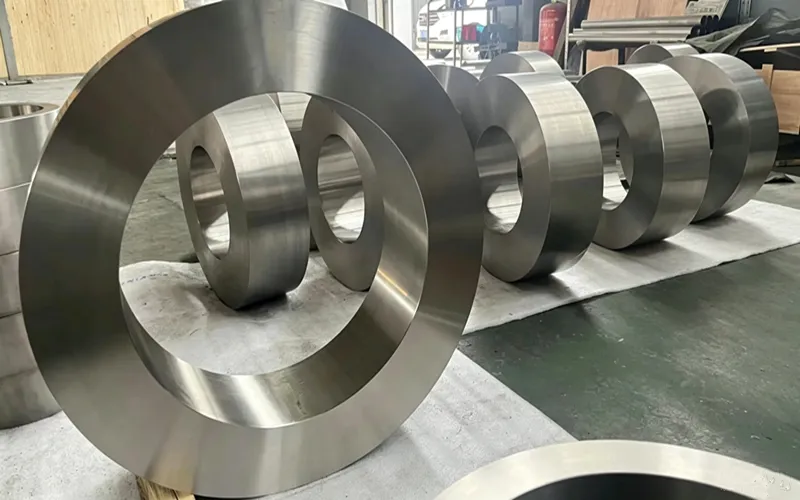
Titanium forgings are widely used in aerospace, marine engineering, chemical processing, energy and other industries where strength, low weight, corrosion resistance and structural reliability are important. However, not all titanium forgings are produced in the same way. Depending on the component's shape, dimensions, mechanical properties and application requirements, different forging methods may be selected.
Four representative methods are open-die forging, closed-die forging, ring rolling and isothermal forging. Each has its own forming principles, advantages and limitations.
It is worth noting that these four methods are not classified on exactly the same basis. Open-die forging, closed-die forging and ring rolling primarily describe how the material is formed, while isothermal forging describes the temperature conditions maintained during forging. Isothermal forging can also use closed-die forming techniques, so it is not necessarily a completely separate category from conventional die forging.
Understanding these differences helps engineers and buyers identify the most suitable forging process for a particular titanium component.
1. Open-Die Forging
Open-die forging is a process in which a titanium billet is compressed between relatively simple dies without being fully enclosed in a shaped cavity. The material is progressively deformed through operations such as upsetting, drawing out and pressing until the required dimensions and shape are achieved.
Because the dies do not define the entire shape of the component, the process offers considerable flexibility in producing different sizes and geometries.
Typical products
Open-die forging is commonly used for titanium forgings such as:
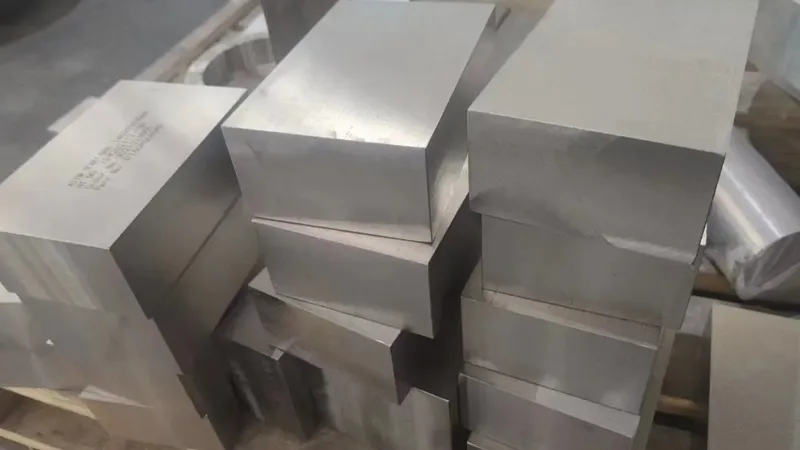
Blocks and billets
Bars and shafts
Discs and pancake-shaped forgings
Large preforms for subsequent machining or further forging
Advantages and limitations
Open-die forging is suitable for large components, customized dimensions and relatively small production batches. It offers flexibility in material size and shape without requiring a dedicated, complex die cavity for every component.
However, achieving intricate geometries and tight dimensional tolerances can be more difficult than with closed-die forging. Many open-die forgings require substantial machining to reach their final dimensions.
Common titanium alloys for open-die forgings include commercially pure titanium grades TA1 (Grade 1) and TA2 (Grade 2), as well as TC4 (Ti-6Al-4V, Grade 5) and other alloys selected according to component size, mechanical requirements and forging conditions.
2. Closed-Die Forging
Closed-die forging, also known as impression-die forging, uses dies with shaped cavities to form the titanium billet. Under compressive force, the heated material flows into the cavity and takes on the shape defined by the dies.
Compared with open-die forging, this method provides greater control over the external geometry and is better suited to components with more complex contours.
Typical products
Closed-die forging can be used to produce:
Aerospace structural components
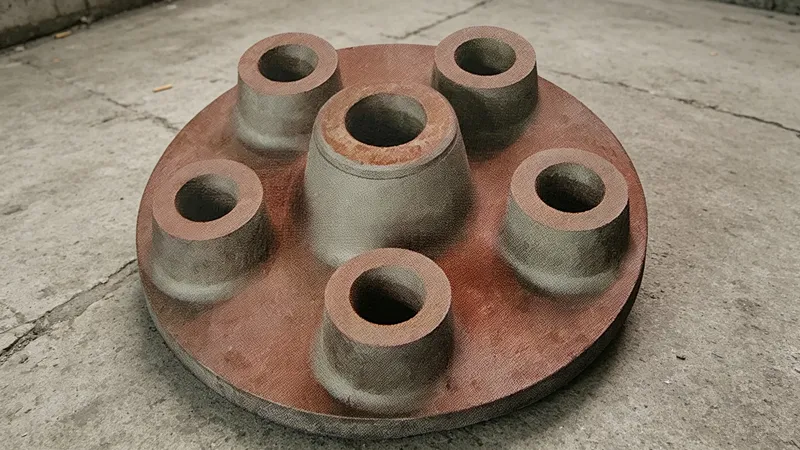
Complex discs and hubs
Connecting and load-bearing components
Components with shaped profiles and integrated features
Advantages and limitations
Closed-die forging can provide good dimensional consistency and repeatability, particularly in established production runs. It can also produce shapes that would require extensive machining if made from a simple billet.
However, the process requires purpose-designed dies, and tooling costs can be substantial. Titanium alloys also present challenges because their deformation behavior is sensitive to temperature and strain rate. In conventional hot closed-die forging, cooling at the die-material interface can increase local deformation resistance and make complete cavity filling more difficult.
For this reason, die design, billet temperature, deformation speed and lubrication must be carefully controlled.
Representative titanium alloys used for closed-die forgings include TC4 (Ti-6Al-4V, Grade 5), TC11 (commonly associated with the Russian BT9 alloy designation), TC17 (Ti-17) and other alloys selected for the required strength, temperature capability and component geometry.
3. Titanium Ring Rolling
Ring rolling is a specialized forming process used to produce seamless ring-shaped components. It typically begins with a preformed ring, which is placed between a driven roll and a mandrel or other forming tools. As the ring is compressed, its wall thickness decreases while its diameter increases.
Depending on the equipment and process configuration, the ring's height and cross-sectional profile can also be controlled.
Unlike open-die and closed-die forging, which can produce a wide range of shapes, ring rolling is specifically intended for ring-shaped products.
Typical products
Titanium rolled rings are used in applications such as:
Aerospace ring components
Flanges and circular structural parts
Large rings for industrial equipment
Ring-shaped components for chemical and marine applications
Advantages and limitations
Ring rolling can produce large-diameter rings with a relatively uniform cross-section and favorable material flow along the ring. It can reduce the need to machine a ring from a much larger solid billet, potentially improving material utilization.
However, ring rolling is not suitable for every component geometry. It requires specialized equipment and an appropriate preform, and the final dimensions and properties depend on the material, rolling schedule and subsequent heat treatment.
For components whose final geometry is fundamentally ring-shaped, ring rolling can be an efficient alternative to machining the ring from solid stock.
Representative titanium alloys that may be considered for ring-rolled forgings include TC4 (Ti-6Al-4V, Grade 5), TC11, TC17 (Ti-17) and other suitable grades. The actual choice depends on the ring dimensions, alloy deformation characteristics, required properties and manufacturing capabilities.
4. Titanium Isothermal Forging
Isothermal forging is a specialized forging process in which the die temperature is maintained close to the temperature of the workpiece during deformation. For titanium alloys, both the billet and the dies are heated to controlled temperatures appropriate for the selected alloy and forging operation.
This differs from conventional hot die forging, where the dies are usually considerably cooler than the billet. When hot titanium contacts a cooler die, its surface can lose heat rapidly. This may create temperature gradients across the workpiece and increase local resistance to deformation.
By keeping the dies and workpiece at similar temperatures, isothermal forging helps reduce these temperature differences and allows the material to deform under more consistent thermal conditions.
Why is isothermal forging used for titanium alloys?
Titanium alloys are sensitive to forging temperature and deformation conditions. These factors affect material flow, microstructure and final mechanical properties. Isothermal forging can be particularly beneficial when a component has complex geometry, thin sections or demanding requirements for structural integrity and dimensional accuracy.
Its main advantages include:
Improved material flow: More consistent temperatures can help titanium fill complex die cavities.
Potentially higher material utilization: Near-net-shape forming can reduce machining allowances and material removed during finishing.
Better control of microstructure: More uniform thermal conditions can help control deformation and microstructural development across different regions of the component.
Potentially improved dimensional accuracy: Controlled forming conditions can help produce components closer to their required final geometry.
These benefits are especially valuable in certain aerospace titanium components, where material costs are high and complex parts may otherwise require extensive machining.
Representative titanium alloys used for isothermal forging include the following Chinese grades and their commonly used international designations:
TC4: Ti-6Al-4V, also known as Grade 5
TC11: Commonly associated with the Russian BT9 designation; exact equivalence depends on the applicable material standard
TC17: Ti-17
TC18: A high-strength titanium alloy; comparisons with other national grades require verification against chemical composition and mechanical property requirements
TC19: Ti-6246, or Ti-6Al-2Sn-4Zr-6Mo
These are representative grades rather than an exhaustive list. The suitability of each alloy for isothermal forging depends on its composition, initial material condition, component design and specified process requirements. International designations should not be treated as automatically interchangeable without checking the relevant standards.
However, isothermal forging is not automatically superior for every titanium component. It requires specialized heated dies, precise temperature control and suitable forging equipment. These requirements increase tooling and process costs. The final microstructure and mechanical properties also depend on the alloy, initial material condition, deformation parameters and subsequent heat treatment.
5. Comparison of Four Titanium Forging Methods
Although all four methods involve the plastic deformation of titanium, their forming principles and typical applications differ.
| Comparison | Open-Die Forging | Closed-Die Forging | Ring Rolling | Isothermal Forging |
|---|---|---|---|---|
| Main principle | Compression between open dies | Forming within shaped die cavities | Rolling a preformed ring to reduce its cross-section and increase its diameter | Forging with the dies and workpiece maintained at similar temperatures |
| Typical shapes | Blocks, shafts, bars and discs | Complex components, hubs and shaped parts | Seamless rings and ring-shaped sections | Complex precision components, discs and thin-section parts |
| Main advantage | Flexibility in size and shape | Good control of component geometry | Efficient production of ring-shaped components | More consistent thermal conditions during deformation |
| Material utilization | Depends on forging allowance and machining required | Can reduce machining compared with machining from solid stock | Can reduce material removal for ring-shaped parts | Can improve material utilization through near-net-shape forming |
| Main limitation | Complex shapes and tight tolerances can be difficult | Dedicated dies and tooling costs | Limited to suitable ring geometries and specialized equipment | High tooling, heating and process-control requirements |
The table provides a general comparison rather than a universal ranking. Actual results depend on component design, alloy selection, production volume and process parameters.
6. How to Choose the Right Titanium Forging Method
Selecting a forging method starts with the component's geometry and functional requirements rather than simply choosing the process with the highest level of precision.
For large blocks, shafts and simple preforms, open-die forging is often a practical option, particularly when flexibility in dimensions is important.
For components with defined contours and more complex external shapes, closed-die forging may provide better geometric control and repeatability, especially in production runs that justify the tooling investment.
For seamless ring-shaped components, ring rolling is often worth considering because the process is specifically designed to form rings efficiently.
For complex titanium components with demanding forming, microstructure or dimensional requirements, isothermal forging may offer important advantages, provided that its additional equipment and tooling costs are justified.
The final decision should also consider the titanium alloy grade, required mechanical properties, machining allowance, production quantity, inspection requirements and total manufacturing cost. The forging process alone does not determine the quality of the finished component; material condition, process control, heat treatment and subsequent machining are also important.
If you are looking for titanium forgings in different shapes, grades and specifications, explore our Titanium Forgings collection to learn more about available products and customized supply options.
Conclusion
Open-die forging, closed-die forging, ring rolling and isothermal forging serve different purposes in titanium component manufacturing. Open-die forging offers flexibility, closed-die forging provides greater control over shaped components, and ring rolling is specialized for ring-shaped products. Isothermal forging, meanwhile, focuses on maintaining similar temperatures between the dies and the workpiece to improve forming conditions for demanding components.
Understanding the distinction between forming methods and temperature-control strategies makes it easier to evaluate which process is appropriate for a given titanium component. The most suitable choice depends on the required shape, material properties, dimensional tolerances, production volume and overall cost.