How to Choose Mirror Finish Aluminum Sheets?
I. What Is a Mirror Finish Aluminum Sheet? Does the Base Material Need Polishing?
A mirror finish aluminum sheet is an aluminum product with a highly reflective surface created through precision rolling and surface finishing. In the industry, it is often called 8K mirror aluminum. Its reflectivity typically ranges from 85% to 95%, comparable to mirror-finished stainless steel. However, it weighs only about one-third as much, making it an excellent lightweight alternative.
Many customers ask whether the base sheet must be polished. The answer depends on the production route.
1. Rolled Mirror Finish (Mainstream Mass Production)
This process does not require large-scale mechanical polishing after rolling.
The production sequence is:
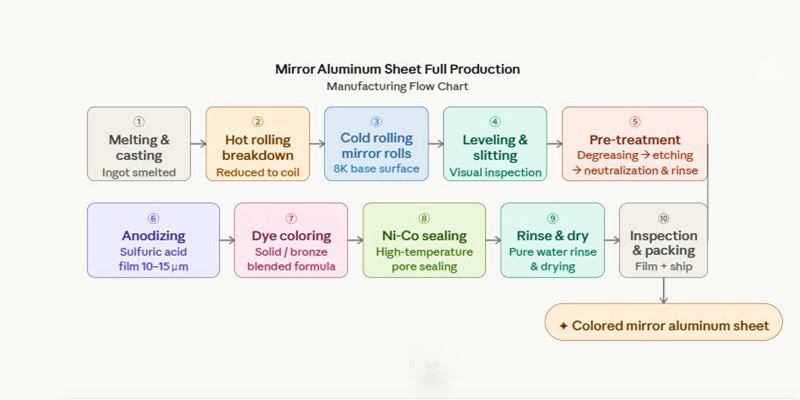
Casting → Hot Rolling → Multi-Pass Precision Cold Rolling
In the final rolling stage, mirror-finished rollers create a highly reflective surface directly on the aluminum sheet.
Advantages:
Uniform surface quality
Excellent flatness
No visible grinding marks
Ideal for large-scale coil production
This is the preferred substrate for colored anodized mirror aluminum.
2. Mechanical or Electrolytic Polished Mirror Finish (Premium Custom Products)
After rolling, the sheet undergoes:
Coarse polishing
Fine polishing
Precision polishing
Alternatively, electrolytic polishing can be used to smooth microscopic surface irregularities.
The surface roughness can reach Ra ≤ 0.1 μm, and reflectivity may exceed 95%.
Advantages:
Ultra-high reflectivity
Nearly flawless appearance
Limitations:
Higher production cost
Lower production efficiency
Typical applications include luxury products and precision optical components.
Quick Summary
For general decoration and lighting applications, rolled mirror aluminum is usually sufficient.
For ultra-high reflectivity and defect-free surfaces, secondary polishing is recommended.
II. How to Choose the Right Alloy for Mirror Aluminum Sheets
The alloy composition directly affects reflectivity, color consistency, and processing performance.
1. 1xxx High-Purity Aluminum Series (Best for Decoration and Optics)
Common grades:
1070
1085
1090
Aluminum purity exceeds 99.7%, with extremely low iron and silicon content.
Advantages:
Highest reflectivity
Excellent formability
Uniform anodizing colors
No color spots or streaks
Limitations:
Lower hardness
Limited structural strength
Applications:
Lighting reflectors
Interior decoration
Signage
Cosmetic packaging
Solar reflector panels
2. 5xxx Aluminum-Magnesium Series (Outdoor and High-Strength Applications)
Common grades:
5005
5754
These alloys contain approximately 3–5% magnesium.
Advantages:
Higher strength
Better corrosion resistance
Excellent outdoor durability
Good resistance to deformation
Limitations:
Slightly lower reflectivity (typically 85–90%)
Dark bronze and antique bronze colors can be more challenging to control
Applications:
Architectural facades
Automotive trim
Outdoor signage
Railway interior panels
3. 6xxx Aluminum-Magnesium-Silicon Series (Structural Applications)
Typical grade:
6061
This alloy can be strengthened through T6 heat treatment.
Advantages:
Highest mechanical strength
Excellent structural performance
Limitations:
Moderate mirror finish quality
Less common in decorative mirror applications
Applications:
Industrial structural components
Load-bearing parts requiring a decorative surface
Shenzhen Chinalcometal offer reflective aluminum mirror sheet (Anodized mirror, rolled mirror, high-reflective mirror), Silver, gold, rose gold, black, blue, custom color available.
III. Complete Manufacturing Process of Premium Colored Mirror Aluminum (Anodized Type)
Colored mirror aluminum generally falls into two categories:
Low-cost laminated products
Premium anodized products
High-end products with long-term color stability must use anodizing technology.
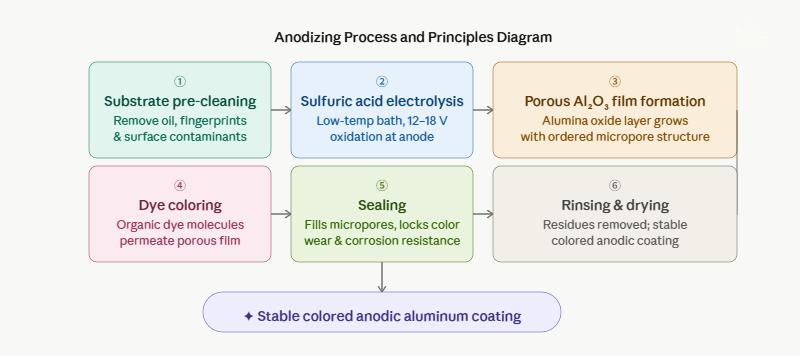
1. Surface Preparation
The surface must be thoroughly cleaned before anodizing.
Steps include:
Ultrasonic degreasing
Light alkaline cleaning
Nitric acid neutralization
Strong alkaline treatment must be avoided because it can permanently dull the mirror surface.
Even minor contamination may cause uneven coloring.
2. Anodizing (Core Process)
The sheet is anodized in a low-temperature sulfuric acid bath.
Typical parameters:
Voltage: 12–18 V
Controlled current density
This creates a transparent anodic oxide layer approximately 10–15 μm thick.
The coating thickness must be carefully controlled.
Too thick: reduced reflectivity
Too thin: poor wear resistance
Mirror aluminum requires much tighter process control than standard brushed aluminum.
3. Coloring
Single-color dyes such as:
Gold
Blue
Rose red
Light purple
usually provide stable and uniform results.
Bronze and antique bronze colors are more difficult because they rely on multiple dye components with different absorption rates.
Even small changes in temperature or pH can cause visible color variation.
4. Sealing
Nickel- or cobalt-based sealing solutions close the microscopic pores in the anodic coating.
Benefits:
Locks color inside the oxide layer
Prevents fading
Improves wear resistance
Insufficient sealing may cause surface discoloration.
Comparison with Laminated Mirror Aluminum
Low-cost laminated products use colored PET film applied to the surface.
Common problems include:
Fading under sunlight
Film peeling
Surface damage
In anodized products, the color becomes part of the metal surface itself.
Advantages:
Excellent scratch resistance
Long-term color stability
Outdoor durability exceeding 10 years
High-end hotels, automotive manufacturers, and precision equipment producers generally prefer anodized mirror aluminum.
IV. Major Applications of Mirror Aluminum Sheets
1. Architectural Decoration
The largest application sector.
Typical uses:
Building facades
Ceilings
Elevator interiors
Exhibition halls
Column cladding
Bronze and champagne mirror finishes create visual depth and reduce the apparent mass of large structures.
2. Lighting and Solar Energy
Applications include:
LED reflectors
Stage lighting reflectors
Solar concentrators
High-reflectivity 1085 mirror aluminum can significantly improve light utilization efficiency.
3. Automotive and Transportation
Applications include:
Dashboard trim
Door trim
Bus and rail interiors
Compared with chrome-plated plastic, mirror aluminum can reduce weight by approximately 40%.
5005 mirror aluminum is widely used in automotive interiors.
4. Electronics and Precision Equipment
Applications include:
Server panels
Instrument control panels
Consumer electronics housings
5. Luxury Packaging and Signage
Applications include:
Premium gift boxes
Metal nameplates
Decorative accessories
Colored anodized mirror aluminum provides a premium appearance while remaining easy to stamp and form.
V. What Is a Mirror Aluminum Composite Panel? How Does It Differ from Solid Mirror Aluminum?
1. Mirror Aluminum Composite Panel (ACP/ACM) Structure
The panel consists of three layers:
Upper mirror aluminum skin (0.25–0.5 mm)
Core layer made of PE or mineral-filled fire-retardant material
Lower mirror aluminum skin (0.25–0.5 mm)
The layers are bonded together under heat and pressure.
Typical panel thickness ranges from 3 mm to 6 mm.
2. Solid Mirror Aluminum Sheet
Solid mirror aluminum is made entirely from aluminum.
Thickness typically ranges from 0.3 mm to 6 mm.
There is no composite core layer.
Key Performance Comparison
| Comparison Item | Mirror ACP/ACM | Solid Mirror Aluminum |
|---|---|---|
| Flatness | Excellent for large panels | May require reinforcement for large sizes |
| Weight | About 60% of solid aluminum panels | Heavier but structurally stronger |
| Fabrication | Cutting and bending only | Suitable for deep drawing, punching, and complex forming |
| Impact Resistance | Thin skins may dent under heavy impact | Better impact resistance |
| Service Life | 8–12 years for PVDF coatings; 3–5 years for PE coatings | Over 15 years with anodized finish |
| Typical Applications | Facades, ceilings, decorative wall panels | Lighting, automotive parts, equipment housings, custom shapes |
VI. Maintenance and Care Guide for Mirror Aluminum Sheets
(A) Maintenance Requirements by Product Type
1. Anodized Colored Mirror Aluminum
This product has a dense sealed oxide layer.
Advantages:
Excellent corrosion resistance
Low maintenance requirements
Avoid:
Strong acids
Strong alkalis
Abrasive polishing
2. PVDF-Coated Mirror Aluminum
The coating provides protection but can be scratched by sharp objects.
Avoid highly concentrated solvents.
3. PET-Laminated Mirror Aluminum
This is the most delicate type.
Avoid:
High temperatures
Strong solvents
Abrasive cleaning
It is best suited for indoor environments.
(B) Routine Cleaning
1. Dust Removal
Use:
Microfiber cloths
Soft dusters
Do not use:
Steel wool
Abrasive pads
Sandpaper
Hard brushes
2. Light Contamination
Examples:
Fingerprints
Water marks
Surface dust
Use a diluted neutral detergent solution.
Wipe gently in one direction.
Dry immediately with a clean cloth.
3. Stubborn Stains
Examples:
Oil
Adhesive residue
Cement spots
For anodized aluminum:
Use a neutral aluminum cleaner.
For laminated products:
Use a small amount of 75% alcohol.
Never use:
Bleach
Toilet cleaners
Oxalic acid
Strong alkaline cleaners
Thinner
Acetone
(C) Outdoor Maintenance
Clean every 3–6 months in coastal or high-humidity areas.
Pay special attention to joints and sealed areas where dirt may accumulate.
Avoid cleaning under direct midday sunlight.
Rapid temperature changes can stress the coating and weaken laminated products.
(D) Practices to Avoid
Do not use steel wool or abrasive pads.
Do not use strong acidic or alkaline cleaners.
Do not scrub aggressively.
Do not expose the surface to high-temperature steam for extended periods.
Protect the panels during construction.
Cement splashes and welding sparks can cause permanent damage.
(E) Repair of Minor Surface Defects
Minor Water Marks or Haze
Clean thoroughly and apply a dedicated aluminum maintenance wax.
Fingerprints or Light Oil Marks
Remove with alcohol and wipe dry.
Deep Scratches or Corrosion
These defects cannot be repaired on-site.
Panel replacement is usually required.
(F) Long-Term Storage
Keep panels off the ground.
Protect from moisture.
Leave the factory protective film in place until installation.
Separate colored anodized panels with soft foam sheets.
VII. Buying Tips and Common Mistakes to Avoid
1. Reflectivity Is Not Everything
For lighting applications, 90% reflectivity is often ideal.
For interior decoration, approximately 86% reflectivity usually provides a more comfortable visual effect.
2. Choose the Right Temper
For bending and forming:
O temper
H24 temper
For flat architectural panels:
H16 temper
H18 temper
These provide better rigidity and flatness.
3. Control Color Consistency
Always approve production samples before mass production.
Bronze and antique bronze colors should be tested in small batches first.
4. Quick Selection Guide
For large facade projects:
Choose mirror ACP/ACM panels.
For stamped parts, complex shapes, and premium long-term performance:
Choose solid anodized 1070 or 1085 mirror aluminum sheets.