What is the Copper Capillary Tube and How Does it Work?
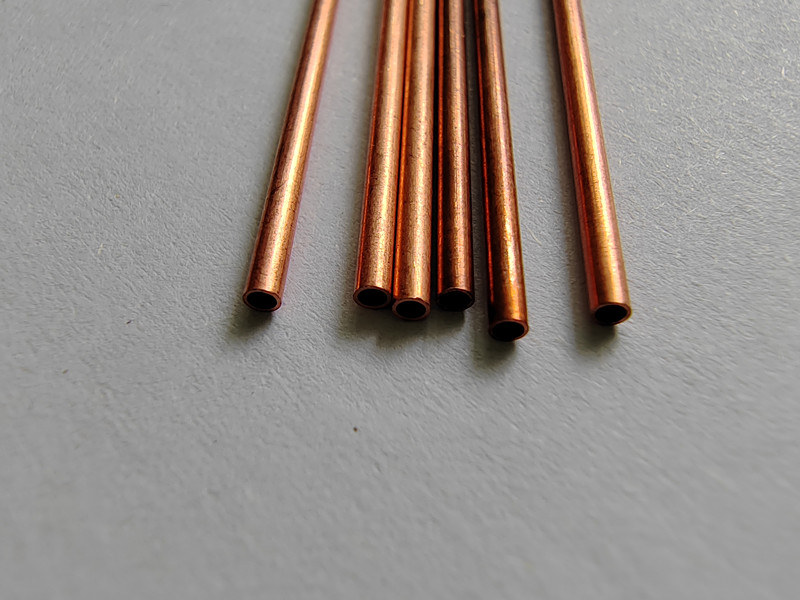
When people hear "copper capillary tube", the first application that comes to mind is usually a refrigerator or air conditioning system. This is understandable because refrigeration is the largest market for capillary tubes.
However, the basic function of a copper capillary tube goes beyond refrigeration.
A capillary tube is a precision small-diameter tube designed to control the flow of liquids or gases. By adjusting the internal diameter, tube length, and flow resistance, it creates a controlled pressure drop and regulates how fast a fluid moves through a system.
In a refrigerator, it controls refrigerant flow before the evaporator. In an instrumentation system, it slows down pressure transmission to protect sensors. In precision equipment, it can regulate small amounts of gas or liquid.
The application changes, but the engineering principle remains the same:
A copper capillary tube is a precision flow-control component.
What Is a Copper Capillary Tube?
A copper capillary tube is a small-diameter copper tube with a precisely controlled inner diameter and wall thickness. Unlike standard copper tubing, which is mainly designed for transporting fluids, capillary tubing is designed to restrict and regulate fluid movement.
The word "capillary" comes from its very small internal passage. When fluid passes through this narrow channel, friction between the fluid and the tube wall creates resistance. This resistance causes a pressure drop, allowing engineers to control the flow rate without using a mechanical valve.
Typical characteristics of copper capillary tubes include:
Small outside diameter
Precise internal diameter control
Thin and uniform wall thickness
Smooth internal surface
Good thermal conductivity
Excellent corrosion resistance
Easy brazing and forming performance
Because of these characteristics, copper remains one of the most common materials for capillary tubing, especially in refrigeration applications.
Copper Capillary Tube vs Regular Copper Tube
Although both products are made from copper, their purposes are different.
| Copper Capillary Tube | Regular Copper Tube | |
|---|---|---|
| Main purpose | Flow restriction and metering | Fluid transportation |
| Internal diameter | Very small and precisely controlled | Larger |
| Typical use | Refrigeration, instruments, precision systems | Plumbing, HVAC piping, heat exchangers |
| Manufacturing requirement | High dimensional accuracy | General tubing tolerance |
A regular copper tube is designed to move fluid efficiently. A capillary tube is designed to control fluid movement.
How Are Copper Capillary Tubes Made?
Manufacturing copper capillary tubes requires more control than producing standard copper tubing. Small changes in internal diameter can affect flow performance, especially in refrigeration systems where the tube itself acts as an expansion device.
1. Copper Material Selection
The manufacturing process starts with selecting the right copper grade.
Common copper materials used for capillary tubes include:
Cu-DHP (CW024A / C12200)
Cu-ETP (CW004A / C11000)
Cu-OF (CW008A / C10200)
For refrigeration systems, Cu-DHP is commonly selected because it provides excellent brazing performance and good resistance to hydrogen embrittlement during heating processes.
For applications requiring higher purity, such as precision instruments or electronic equipment, oxygen-free copper grades may be preferred.
2. Tube Forming and Cold Drawing
Copper capillary tubes are generally produced through a series of forming and sizing processes.
A typical production process includes:
Copper billet → Extrusion → Cold drawing → Annealing → Precision sizing →Straightening →Cleaning → Cutting or coiling
Cold drawing is one of the most important steps because it reduces the tube diameter while improving dimensional accuracy.
During drawing, manufacturers control:
Outside diameter
Inside diameter
Wall thickness
Surface quality
For capillary tubes, even a small variation in internal diameter can change the pressure drop and affect system performance.
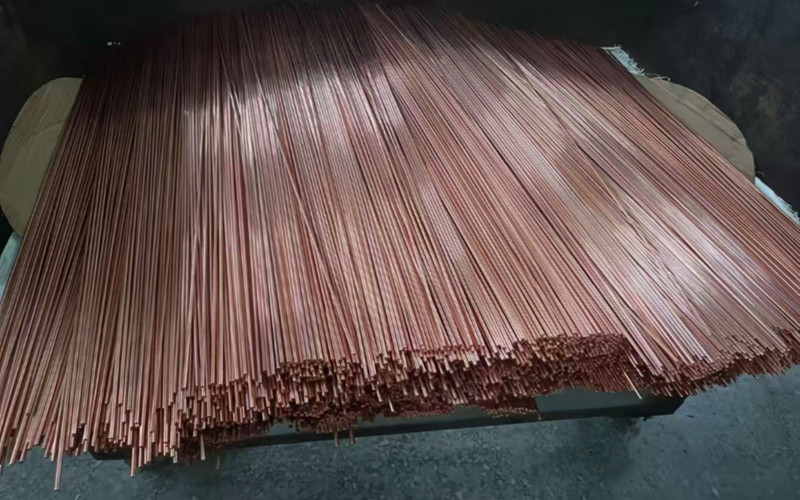
We supply straight and coiled capillary tubes, for more details about copper grades, dimensions, and manufacturing options, see our Precision Copper Capillary Tube (Cu-OF / Cu-ETP / Cu-DHP) product page.
3. Cleaning and Surface Control
Because capillary tubes have very small internal passages, cleanliness is critical.
Manufacturers need to remove:
Drawing lubricants
Metal particles
Oxide residues
Manufacturing contaminants
A clean internal surface helps maintain stable fluid flow and reduces the risk of blockage during operation.
How Does a Copper Capillary Tube Work?
The working principle of a copper capillary tube is based on controlled flow resistance.
When fluid enters a small-diameter tube, the narrow passage creates friction. This friction reduces pressure and limits the amount of fluid passing through the tube.
The main factors affecting capillary tube performance include:
Internal diameter
Tube length
Fluid properties
Pressure difference
Temperature conditions
A smaller diameter or longer tube usually creates greater resistance and lower flow.
How Does a Capillary Tube Work in a Refrigerator?
In refrigeration systems, the capillary tube works as a fixed expansion device.
The refrigeration cycle typically follows:
Compressor → Condenser → Capillary Tube → Evaporator → Compressor
After leaving the condenser, the refrigerant is a high-pressure liquid. When it passes through the capillary tube:
The small internal passage restricts refrigerant flow.
Pressure drops significantly.
Refrigerant temperature decreases.
The low-pressure refrigerant enters the evaporator and absorbs heat.
The capillary tube does not actively adjust flow like an electronic expansion valve. Instead, it provides a fixed restriction designed according to the refrigeration system requirements.
What Is the Purpose of a Capillary Tube in HVAC Systems?
In HVAC applications, the purpose of a capillary tube is to regulate refrigerant flow and maintain the pressure difference between the high-pressure and low-pressure sides of the system.
Typical HVAC applications include:
Small air conditioners
Window AC units
Portable air conditioners
Heat pumps
Dehumidifiers
Compared with expansion valves, capillary tubes have a simpler structure and lower cost, making them suitable for smaller refrigeration systems.
Applications of Copper Capillary Tubes
Although refrigeration is the largest application, copper capillary tubes are used anywhere precise flow control is required.
The specific fluid may change, but the basic function remains the same: controlling the movement of gas or liquid.
Refrigeration Systems
In refrigeration systems, the capillary tube controls refrigerant flow by creating a pressure drop between the condenser and evaporator.
Typical Applications
Household refrigerators
Freezers
Ice makers
Beverage coolers
Display refrigerators
Small refrigeration equipment
HVAC Systems
In HVAC equipment, the capillary tube meters the amount of refrigerant entering the evaporator, helping maintain stable cooling performance.
Typical Applications
Mini split air conditioners
Portable air conditioners
Heat pump systems
Dehumidifiers
Automotive Thermal Management
In automotive systems, capillary tubes help control refrigerant or coolant movement in compact thermal management circuits where space is limited.
Typical Applications
Automotive air conditioning systems
Electric vehicle battery cooling systems
Compact cooling modules
Instrumentation and Pressure Control
In measurement systems, copper capillary tubes are used to slow down pressure changes and provide controlled pressure transmission between the sensing point and measuring device.
Typical Applications
Pressure gauges
Temperature controllers
Pressure switches
Industrial sensors
Medical and Laboratory Equipment
Medical and laboratory systems often require accurate and stable gas or liquid delivery. Capillary tubes provide controlled metering where small flow rates are required.
Typical Applications
Gas control systems
Analytical instruments
Laboratory cooling equipment
Precision Industrial Equipment
In precision equipment, copper capillary tubes regulate cooling fluids or process gases where stable flow and dimensional accuracy are important.
Typical Applications
Semiconductor equipment
Vacuum systems
Electronic manufacturing equipment
Precision cooling systems
A partially clogged copper capillary tube can cause
Because copper capillary tubes have very small internal passages, contamination can easily affect performance.
A partially clogged capillary tube can cause:
Reduced refrigerant flow
Poor cooling performance
Longer operating time
Uneven temperature control
Low evaporator pressure
Why Do Copper Capillary Tubes Get Blocked?
1. Moisture Contamination
Moisture inside refrigeration systems can freeze at low temperatures and create ice blockage inside the capillary tube.
2. Dirt and Particles
Small particles from manufacturing residue, corrosion, or improper system cleaning can restrict the narrow passage.
3. Oil or Chemical Contamination
Excessive oil or incompatible materials may accumulate inside the tube and reduce flow.
How to Deal With a Blocked Capillary Tube?
In most cases, the solution depends on the cause and severity of the blockage.
Common approaches include:
Checking and removing system contamination
Flushing the refrigeration circuit
Replacing the damaged capillary tube
For manufacturers and system builders, preventing contamination during assembly is usually more effective than repairing a blocked tube later.
How to Cut Copper Capillary Tubes?
Cutting copper capillary tubes requires more care than cutting standard copper tubing because the internal passage is extremely small.
Common cutting methods include:
Tube Cutter
Suitable for small quantities and manual processing.
Advantages:
Clean cutting surface
Minimal deformation
Precision Saw Cutting
Used for larger production quantities where consistent length control is required.
After Cutting
The tube should be:
Deburred
Cleaned
Inspected
Any burr or particle left inside the tube may affect flow performance.
How to Choose the Right Copper Capillary Tube?
Choosing a copper capillary tube depends on the actual application requirements.
Important factors include:
1. Inner Diameter
The internal diameter directly affects flow resistance.
2. Tube Length
A longer tube creates greater resistance.
3. Copper Grade
Different copper grades provide different levels of:
Conductivity
Purity
Brazing performance
4. Application Environment
Consider:
Temperature range
Pressure conditions
Fluid type
Installation method