ERTi-1 | ERTi-2 | ERTi-3 | ERTi-4 | ERTi-5 Titanium Wire— Classification, Properties, Applications
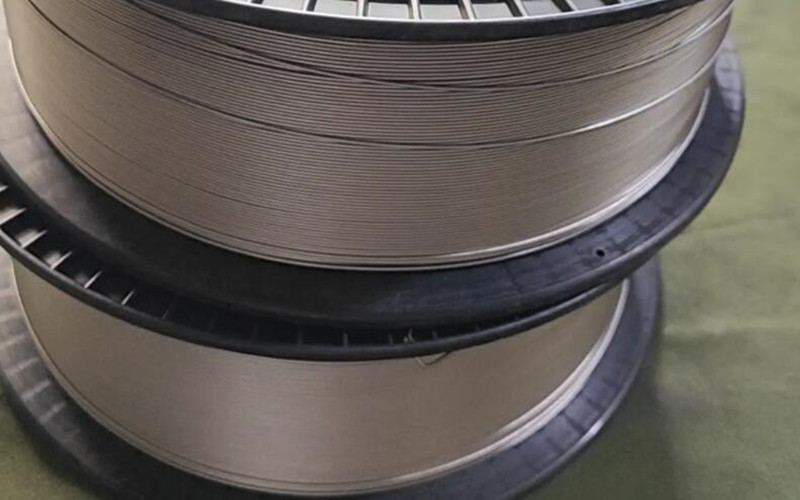
What Is Titanium Welding Wire?Titanium welding wire is a filler material used in arc welding processes — primarily Gas Tungsten Arc Welding (GTAW/TIG) and Plasma Arc Welding (PAW) — to join titanium base metals or to weld titanium components to compatible dissimilar metals. It serves the same functional role as stainless steel or aluminum filler wire, but the metallurgical behavior of titanium during welding demands a fundamentally different approach.
Unlike most structural metals, titanium begins absorbing oxygen, nitrogen, and hydrogen from the atmosphere at temperatures above 260°C (500°F). Contamination at the weld pool, heat-affected zone, or even the cooling weld bead causes embrittlement, porosity, and loss of corrosion resistance — defects that may not be visible to the naked eye but can lead to premature failure in service.
For this reason, titanium welding wire is produced and packaged under strict cleanliness controls, and its use requires inert gas shielding at every stage of the welding process. When handled and applied correctly, titanium welds can match or exceed the mechanical properties of the base metal, with the corrosion resistance fully preserved.
Classification of Titanium Welding Wire
Titanium welding wires are classified into two fundamentally different groups based on their microstructure and alloy content. Understanding this distinction is essential before any grade selection.
Commercially Pure (CP) Titanium — ERTi-1 to ERTi-4
Commercially pure (CP) titanium welding wires contain no intentional alloying elements. The only variables between grades are the maximum permitted levels of interstitial elements — oxygen, nitrogen, carbon, hydrogen, and iron — which increase from Grade 1 through Grade 4. As these interstitial levels rise, tensile strength increases and ductility decreases. All four grades offer excellent corrosion resistance and full biocompatibility.
Titanium Alloy — ERTi-5 and Above
Alloyed titanium welding wires contain deliberate additions of elements such as aluminum, vanadium, molybdenum, niobium, or palladium to achieve specific mechanical or corrosion properties. ERTi-5 (Ti-6Al-4V) is the most widely used alloy wire, containing 6% aluminum and 4% vanadium. Its strength, weldability, and broad availability make it the industry standard for structural titanium fabrication.
Naming Convention
Designation | Common Name | Category | AWS / ASME Grade |
ERTi-1 | CP Grade 1 | Commercially Pure | GR1 |
ERTi-2 | CP Grade 2 | Commercially Pure | GR2 |
ERTi-3 | CP Grade 3 | Commercially Pure | GR3 |
ERTi-4 | CP Grade 4 | Commercially Pure | GR4 |
ERTi-5 | Ti-6Al-4V | α+β Alloy | GR5 |
ERTi-23 | Ti-6Al-4V ELI | α+β Alloy (ELI) | GR23 |
ERTi-7 | Ti-0.2Pd | CP + Palladium | GR7 |
ERTi-9 | Ti-3Al-2.5V | α Alloy | GR9 |
ERTi-12 | Ti-0.3Mo-0.8Ni | CP + Mo/Ni | GR12 |
Why ERTi-5 Is Different from ERTi-1 to ERTi-4
ERTi-1 through ERTi-4 are variations of the same base material — unalloyed titanium — differentiated only by purity level. Their corrosion behavior is similar, their weld metallurgy follows the same principles, and they are interchangeable in many low-to-moderate strength applications.
ERTi-5 is a different material category. The addition of 6% aluminum and 4% vanadium creates a two-phase (alpha + beta) microstructure that behaves fundamentally differently during welding and in service:
Tensile strength of ERTi-5 weld deposits (typically 900–950 MPa) is nearly double that of ERTi-2 (450–520 MPa)
ERTi-5 welds are not used in the as-welded condition for critical applications — post-weld heat treatment (PWHT) is typically required to relieve residual stress and restore ductility
ERTi-5 has lower corrosion resistance than CP grades in certain aggressive media such as hot concentrated acids — its strength advantage does not extend to corrosion performance
ERTi-5 cannot be substituted for CP grades in medical implant applications — ERTi-23 (ELI grade) is the correct choice for biomedical use
In practice, the choice between CP grades (ERTi-1 to ERTi-4) and ERTi-5 is a structural vs. corrosion trade-off: choose CP grades when corrosion resistance, ductility, and biocompatibility are the priority; choose ERTi-5 when high strength is the dominant requirement.
Mechanical Property Comparison
The following table summarizes the as-deposited weld metal mechanical properties for the five principal grades per AWS A5.16.
Grade | UTS (MPa) | Yield Strength (MPa) | Elongation (%) | Hardness (HRC approx.) |
ERTi-1 | 240 min | 170 min | 24 min | ~70 HRB |
ERTi-2 | 345 min | 275 min | 20 min | ~80 HRB |
ERTi-3 | 450 min | 380 min | 18 min | ~90 HRB |
ERTi-4 | 550 min | 483 min | 15 min | ~20 HRC |
ERTi-5 | 895 min | 828 min | 10 min | ~33 HRC |
Key Observations
The progression from ERTi-1 to ERTi-4 is nearly linear: each grade step adds roughly 100–130 MPa in UTS while reducing elongation by 2–3 percentage points. This allows engineers to select the precise balance for their application without overspecifying.
ERTi-5 represents a step-change in strength rather than a linear continuation of the CP series. Its yield strength of 828 MPa minimum is approximately three times that of ERTi-2, which is why it has become the dominant grade in aerospace structural fabrication.
Applications & Base Metal Matching by Grade
Selecting the correct welding wire grade requires matching three factors: the base metal being welded, the mechanical performance requirements of the joint, and the service environment. The following sections address each grade in turn.
1. ERTi-1 — Maximum Ductility, Highest Purity
ERTi-1 is the softest and most ductile of all titanium welding wires, with the lowest interstitial content permitted under AWS A5.16. Its primary advantages are exceptional formability of the weld deposit and the highest biocompatibility of any CP grade.
Primary Applications
Medical device fabrication: surgical instrument components, implant housings, and dental frameworks where biocompatibility is mandatory
Thin-wall and complex-geometry parts where post-weld forming is required — ERTi-1 deposits remain workable after welding
Laboratory and pharmaceutical equipment requiring ultra-high purity surfaces
Welding GR1 base metal — matching filler is preferred when corrosion resistance must be preserved uniformly across the weld zone
Base Metal Compatibility
Base Metal | Recommended Filler | Notes |
GR1 Ti | ERTi-1 | Exact match; preferred for medical and high-purity applications |
GR2 Ti | ERTi-1 or ERTi-2 | ERTi-1 acceptable when additional ductility is needed |
GR1 to GR2 dissimilar | ERTi-1 | Lower-strength filler prevents joint overmatch issues |
2. ERTi-2 — The Industrial Standard
ERTi-2 is the most widely used titanium welding wire in the world. It represents the optimal balance of strength, ductility, corrosion resistance, and weldability for general industrial fabrication. When a specification calls for 'CP titanium welding wire' without specifying a grade, ERTi-2 is the default assumption.
Primary Applications
Chemical processing equipment: reactors, columns, piping systems, and heat exchangers in service with acids, chlorides, and oxidizing media
Desalination plant components: evaporators, tubing bundles, and brine-handling systems where seawater corrosion resistance is critical
Pulp and paper industry: bleach plant piping and equipment exposed to hypochlorite and chlorine dioxide solutions
Industrial heat exchangers: tube-to-tubesheet welding in titanium shell-and-tube exchangers
Marine hardware and offshore equipment: fittings, valves, and structural members in seawater service
Food processing and beverage equipment: where titanium is specified for corrosion resistance and FDA-compatible surfaces
Base Metal Compatibility
Base Metal | Recommended Filler | Notes |
GR2 Ti | ERTi-2 | Standard matching filler for most GR2 fabrications |
GR1 Ti | ERTi-2 | Slight strength overmatch acceptable for structural joints |
GR3 Ti | ERTi-2 | Used when GR3 strength is not required at the weld |
GR7 Ti (Ti-0.2Pd) | ERTi-2 or ERTi-7 | ERTi-2 acceptable for structural joints; ERTi-7 when corrosion matching is critical |
3. ERTi-3 — Precision Strength Matching
ERTi-3 occupies the middle ground in the CP series. It is specified when GR2 strength is insufficient but GR4 hardness would compromise joint ductility or formability. In practice, ERTi-3 is the least commonly stocked grade — many suppliers carry ERTi-2 and ERTi-4 as standard, with ERTi-3 available on indent — but it fills a genuine engineering need in pressure vessel and structural applications.
Primary Applications
Pressure vessel fabrication to ASME Section VIII where GR3 base metal is specified for higher design pressure ratings
Structural brackets and frames in chemical plant where the component carries moderate loads in a corrosive environment
Aerospace skin and duct sections where corrosion resistance must be maintained and GR2 lacks the required design strength
Repair welding of GR3 or GR4 components where preserving the original strength grade is required by the welding procedure specification (WPS)
Base Metal Compatibility
Base Metal | Recommended Filler | Notes |
GR3 Ti | ERTi-3 | Matching filler for code-qualified GR3 procedures |
GR2 Ti (high-load) | ERTi-3 | Used when joint strength must exceed ERTi-2 deposit minimum |
GR4 Ti (repair) | ERTi-3 or ERTi-4 | ERTi-3 preferred if ductility is more critical than full strength restoration |
4. ERTi-4 — Maximum CP Strength
ERTi-4 is the strongest commercially pure titanium welding wire, with a minimum UTS of 550 MPa — more than double that of ERTi-1. It is specified where load-bearing capacity is the design constraint but where the alloy additions in ERTi-5 are unacceptable due to corrosion requirements or biocompatibility concerns.
Primary Applications
Shipbuilding and naval construction: hull fittings, shaft brackets, and sonar dome structures where CP titanium is specified for seawater resistance under structural loading
Nuclear industry: heat exchanger tubing and pressure boundary components where strict material qualification rules and corrosion performance preclude alloy grades
Heavy-wall chemical process vessels: nozzles, flanges, and supports fabricated from GR4 plate where full-strength welds are required by the design code
Offshore and subsea hardware: clamps, manifolds, and fastener assemblies in deepwater environments
Base Metal Compatibility
Base Metal | Recommended Filler | Notes |
GR4 Ti | ERTi-4 | Matching filler; required for code procedures specifying GR4 weld deposit strength |
GR3 Ti (heavy-section) | ERTi-4 | Overmatch acceptable for structural weld joints under ASME/AWS rules |
GR2 Ti (structural) | ERTi-4 | Used when joint is the stress concentration location and must not be the weak point |
5. ERTi-5 — Structural Workhorse of the Alloy World
ERTi-5 (Ti-6Al-4V, Grade 5) is the most widely produced titanium alloy in the world, and its welding wire counterpart follows the same dominance in the alloy wire market. With a minimum UTS of 895 MPa, ERTi-5 weld deposits approach the strength of medium-carbon steel while maintaining titanium's weight advantage and corrosion resistance in most industrial environments.
Primary Applications
• Aerospace structures: fuselage frames, bulkheads, engine mounts, and wing attachment fittings fabricated from GR5 or GR23 sheet and forgings
• Jet engine components: fan cases, exhaust nozzles, and low-pressure turbine housings where the strength-to-weight ratio is the governing design criterion
• Sports and recreational equipment: high-performance bicycle frames, golf club heads, and motorsport components where weight reduction justifies the higher material cost
• Military and defense hardware: armored vehicle components, missile bodies, and submarine fittings
• Medical implants (as ERTi-23 ELI): hip and knee replacement stems, spinal fixation devices, and bone plates — note that ERTi-23, the extra-low-interstitial (ELI) variant, is used here rather than standard ERTi-5
Base Metal Compatibility
Base Metal | Recommended Filler | Notes |
GR5 Ti-6Al-4V | ERTi-5 | Standard matching filler for structural aerospace and industrial fabrication |
GR23 Ti-6Al-4V ELI | ERTi-23 | ELI filler required for medical and cryogenic applications |
GR9 Ti-3Al-2.5V | ERTi-5 or ERTi-9 | ERTi-5 for structural; ERTi-9 preferred for tubing and hydraulic systems |
GR5 to CP Ti dissimilar | ERTi-2 | Low-strength CP filler recommended to prevent overmatch cracking at transition |
How to Choose the Right Titanium Welding Wire
Grade selection for titanium welding wire follows a structured decision process. Answering the following questions in order leads to the correct specification in most cases.
Step 1 — Identify the Base Metal Grade
The starting point is always the base metal specification. In most qualified welding procedures (per ASME IX or AWS D1.9), the filler metal must produce a weld deposit with mechanical properties at or above the base metal minimum. As a general rule, match the filler grade to the base metal grade.
Step 2 — Evaluate the Service Environment
If the primary concern is corrosion resistance rather than strength, consider the following:
For service in hot concentrated acids (sulfuric, hydrochloric) or reducing media: consider ERTi-7 (Ti-0.2Pd) or ERTi-12 (Ti-0.3Mo-0.8Ni) rather than standard CP grades
For seawater, chloride, and oxidizing acid service: ERTi-2 provides excellent performance and is usually the most cost-effective choice
For crevice corrosion resistance: ERTi-12 offers superior crevice performance compared to ERTi-2 or ERTi-7
Step 3 — Check Strength Requirements
If the joint is load-bearing, compare the design stress against the minimum weld deposit UTS for each candidate grade. Use the mechanical property table in Section 4 as the starting reference. Remember that ERTi-5 weld metal may require PWHT to achieve the elongation values listed in the welding procedure.
Step 4 — Consider Biocompatibility and Regulatory Requirements
Medical device applications require ISO 5832-2 or ASTM F136-compliant material. Standard ERTi-5 does not meet this requirement — specify ERTi-23 (ELI grade) for all implantable applications. Aerospace applications governed by AMS specifications should confirm that the wire lot carries the correct AMS certification (e.g., AMS 4951 for ERTi-1, AMS 4952 for ERTi-2).
Quick Selection Reference
Application Type | Recommended Grade | Key Reason |
General chemical processing | ERTi-2 | Best balance of corrosion resistance and cost |
Medical devices / implants | ERTi-1 or ERTi-23 | Biocompatibility; ERTi-23 for structural implants |
Aerospace structures | ERTi-5 | High strength-to-weight; matches GR5 base metal |
Naval / heavy industrial | ERTi-4 | Maximum CP strength without alloy additions |
Pressure vessels (GR3 base) | ERTi-3 | Code-compliant strength match for GR3 |
Hot acid / reducing service | ERTi-7 / ERTi-12 | Palladium or Mo/Ni additions for crevice resistance |
Thin-wall or post-weld forming | ERTi-1 | Maximum ductility in the weld deposit |
Cryogenic applications | ERTi-23 (ELI) | ELI grade maintains toughness at low temperatures |
Welding Process & Shielding Gas Requirements
Titanium welding differs from steel and aluminum welding primarily in the demand for contamination control. The metal's reactivity with atmospheric gases at elevated temperatures requires shielding gas coverage not just at the weld pool, but across the entire heat-affected zone and the cooling weld bead.
Recommended Welding Processes
GTAW (TIG): The dominant process for titanium welding wire. Provides the finest arc control, lowest heat input, and best shielding gas management. Suitable for all grades and most thickness ranges.
PAW (Plasma Arc Welding): Used for higher-speed production welding of consistent joint geometries. Preferred for automated tube and pipe welding.
GMAW (MIG): Limited use for titanium — higher heat input and spatter generation increase contamination risk. Only recommended for thicker sections with specialized equipment.
Laser welding with filler wire: Growing application in aerospace and medical manufacturing where precision and minimal heat input are required.
Shielding Gas Specification
Argon (Ar) at 99.999% purity minimum is the standard shielding gas for all titanium grades. Helium may be blended for deeper penetration on thick sections. Gas mixtures containing nitrogen or CO2 are strictly prohibited.
Shielding Zone | Purpose | Gas Specification | Coverage Method |
Primary (torch cup) | Protects the weld pool and arc | Ar 99.999% | Standard GTAW cup; gas lens recommended |
Trailing shield | Protects the solidifying weld bead to <260°C | Ar 99.999% | Trailing shoe or extended cup; 150–300 mm long |
Backing / purge gas | Protects the weld root on reverse side | Ar 99.999% | Purge dam or fixture; monitor O2 to <50 ppm |
Fixture atmosphere (critical) | Full enclosure for aerospace-grade work | Ar 99.999% | Glove box or welding chamber |
Wire Diameter Selection
Base Metal Thickness | Recommended Wire Diameter | Notes |
< 1.5 mm | 0.8 – 1.0 mm | Thin-wall sheet and tubing |
1.5 – 3.0 mm | 1.0 – 1.6 mm | Light structural and vessel fabrication |
3.0 – 6.0 mm | 1.6 – 2.4 mm | Medium-wall pipe and plate |
6.0 – 12 mm | 2.4 – 3.2 mm | Heavy-wall structural; multi-pass |
> 12 mm | 3.2 mm (multi-pass) | Heavy sections require preheat evaluation |
Common Welding Challenges and Precautions
1.Atmospheric Contamination
Contamination is the primary failure mode in titanium welding. The most common causes are insufficient shielding gas flow, drafts in the welding environment, leaks in the purge system, and premature removal of the trailing shield before the weld cools below 260°C. Any visible discoloration beyond light straw indicates contamination and the weld should be assessed against the applicable acceptance criteria before continuing.
2. Surface Cleanliness
All surfaces — base metal, filler wire, fixtures, and the welder's gloves — must be free of oil, grease, moisture, and oxide scale before welding begins. The standard preparation sequence is: degrease with acetone or approved solvent, mechanical abrasion with dedicated stainless steel wire brushes (never shared with other metals), followed by a second solvent wipe. Bare hands must never contact the wire or the weld zone after cleaning.
3. Porosity in ERTi-5 Welds
Porosity is more commonly encountered with ERTi-5 than with CP grades and is typically caused by hydrogen from moisture on the base metal or wire surface, or from contaminated shielding gas. ERTi-5 welds should be radiographically inspected to Level 2 porosity acceptance per AWS D1.9 for structural applications. Wire that has been exposed to humidity should be baked at 120°C for 2 hours before use.
4. Post-Weld Heat Treatment (PWHT) for ERTi-5
ERTi-5 weld deposits in the as-welded condition typically show reduced ductility compared to annealed wrought material. For applications where the elongation minimum must be met (aerospace, pressure vessels), stress relief at 595–705°C in an inert atmosphere or vacuum for 1–4 hours is standard practice. CP grades (ERTi-1 to ERTi-4) do not normally require PWHT unless distortion control is needed.
5. Dissimilar Metal Welding
Titanium can be welded to certain other metals — notably tantalum, niobium, and some stainless steels using transition inserts — but direct fusion welding of titanium to steel or aluminum produces brittle intermetallic compounds and is not recommended. When welding dissimilar titanium grades, use the lower-strength CP filler to prevent overmatch conditions that concentrate stress at the weld interface.
Storage & Handling
Titanium welding wire requires more careful storage than most filler metals due to its susceptibility to surface contamination.
Store in original sealed packaging in a clean, dry environment at controlled temperature (15–30°C) and relative humidity below 60%
Keep away from oils, solvents (other than the approved cleaning agents), chloride-containing compounds, and halogenated materials
Once a coil or straight-length pack is opened, unused wire should be resealed in clean polyethylene bags with desiccant — do not store in cardboard or open racks
Mark opened packages with the date of first use; wire exposed to ambient conditions for more than 72 hours in humid environments should be inspected and baked before use
Handle wire only with clean, lint-free gloves — cotton or nitrile; never bare hands or leather gloves
Dedicated storage: titanium wire storage should be physically separated from steel, aluminum, and stainless steel wire to prevent cross-contamination from wire particles and metallic dust
Wire with visible surface discoloration (iridescence, gray or black patches) should not be used. Return to supplier for evaluation or dispose of. Surface contamination on the filler wire will be transferred directly to the weld pool.
Future Market Outlook
The titanium welding wire market is positioned for sustained growth through the end of the decade, driven by structural trends across its three principal end markets.
Aerospace Production Recovery and Ramp
Commercial aircraft production rates at both Airbus and Boeing are scheduled to increase substantially through 2027–2030 to address order backlogs accumulated during the post-pandemic recovery period. Each narrow-body aircraft contains 40–80 kg of titanium weld filler material across structural and engine applications. The high-rate production environment is expected to drive demand for ERTi-5 and ERTi-23 in particular.
Global Water Infrastructure Investment
Desalination capacity is expanding rapidly across the Middle East, North Africa, and South and Southeast Asia in response to freshwater scarcity. Titanium — particularly GR2 and its welding consumable ERTi-2 — is the material of choice for large-scale seawater reverse osmosis and multi-effect distillation plants due to its unmatched corrosion resistance in chloride environments. Project pipelines through 2030 suggest compound annual demand growth of 6–9% for ERTi-2 in this segment.
Medical Device and Implant Growth
Aging demographics in developed markets and increasing access to elective orthopedic and dental procedures in emerging markets are driving sustained demand for ERTi-23 and ERTi-1. Additive manufacturing (wire arc additive manufacturing / WAAM) is creating new demand for fine-diameter titanium wire beyond traditional welding, with the medical sector a primary early adopter.
Energy Transition Applications
Hydrogen production via PEM electrolysis, offshore wind installation hardware, and heat exchangers for geothermal energy all represent growing applications for titanium in aggressive service environments. While individually smaller than aerospace or chemical processing, these applications collectively represent a new demand vector for ERTi-2 and specialty grades like ERTi-7 and ERTi-12.
Conclusion
Titanium welding wire encompasses a family of materials that span a wide range of mechanical and corrosion performance — from ultra-pure ERTi-1 for medical and precision fabrication, through the industrial workhorse ERTi-2, to the high-strength ERTi-5 that underpins modern aerospace manufacturing. Each grade exists for a reason, and substitution between grades should only occur when formally evaluated against the applicable welding procedure specification and acceptance criteria.
The key decision axes are straightforward: match the base metal grade as the starting point, adjust for corrosion service conditions or biocompatibility requirements, and confirm that the weld deposit mechanical properties meet the design code minimum. When in doubt about grade selection for a specific application, consult the applicable welding procedure, the material certification documentation, and — where safety-critical applications are involved — a qualified welding engineer.
Regardless of grade selected, the fundamental requirement for titanium welding success remains constant: control contamination at every stage, maintain argon shielding until the weld and heat-affected zone have cooled, and handle all materials with the cleanliness that titanium demands and deserves.
Standards Referenced in This Document
• AWS A5.16 / ASME SFA-5.16: Specification for Titanium and Titanium Alloy Welding Electrodes and Rods
• ISO 24034: Welding consumables — Solid wire electrodes, solid wires and rods for fusion welding of titanium and titanium alloys
• ASTM B863: Standard Specification for Titanium and Titanium Alloy Wire
• AMS 4951 / 4952 / 4954 / 4956: AMS wire specifications for ERTi-1 through ERTi-4
• AMS 4928 / AMS 4954: AMS specifications for Ti-6Al-4V (GR5) material
• ASTM F136: Standard Specification for Wrought Ti-6Al-4V ELI Alloy for Surgical Implant Applications
• ISO 5832-2: Implants for surgery — Metallic materials — Unalloyed titanium
• ASME Boiler and Pressure Vessel Code, Section IX: Welding and Brazing Qualifications