What Is Oxygen-Free Copper? Cu-OFE vs Cu-OF vs Cu-ETP
Copper remains the most widely used conductive material in electrical, electronic, power transmission, and industrial applications. However, not all copper grades are the same. Differences in oxygen content, purity, conductivity, and manufacturing methods can significantly affect performance, reliability, and long-term service life.
For engineers, equipment manufacturers, and procurement specialists, understanding the differences between Cu-ETP (C11000), Cu-OF (C10200), and Cu-OFE (C10100) is essential when selecting materials for busbars, hollow conductors, water-cooled conductors, transformer windings, RF systems, and vacuum applications.
This article explains what oxygen-free copper is, why it matters, how it is produced, and which copper grade is best suited for different conductor applications.
What Is Oxygen-Free Copper?
Oxygen-free copper (OFC) is a high-purity copper material manufactured with extremely low oxygen content. In most cases, oxygen levels are limited to 0.003% (30 ppm) or lower, while copper purity exceeds 99.95%.
By comparison, standard electrolytic tough pitch copper (ETP copper) typically contains between 0.02% and 0.04% oxygen. Although ETP copper offers excellent conductivity and remains the industry standard for many electrical applications, the presence of oxygen can create limitations in demanding environments.
The key difference lies in the copper's microstructure. Oxygen in copper primarily exists as cuprous oxide (Cu₂O), which tends to accumulate along grain boundaries. These oxide inclusions can influence conductivity, weldability, high-temperature performance, and resistance to hydrogen embrittlement.
Oxygen-Free Copper vs. ETP Copper
| Property | Oxygen-Free Copper (OFC) | ETP Copper |
|---|---|---|
| Oxygen Content | ≤ 0.003% | 0.02–0.04% |
| Copper Purity | ≥ 99.95% | ≥ 99.90% |
| Conductivity | ≥ 101% IACS | Approximately 100% IACS |
| Hydrogen Embrittlement Resistance | Excellent | Moderate |
| Vacuum Compatibility | Excellent | Limited |
| Relative Cost | Higher | Lower |
Although the difference in conductivity may appear small on paper, material purity becomes increasingly important in high-current, high-frequency, vacuum, and precision electrical applications.
Why Was Oxygen-Free Copper Developed?
The development of oxygen-free copper was driven by the need for improved electrical performance and greater reliability under demanding operating conditions.
Higher Conductivity
Copper oxide inclusions are significantly less conductive than pure copper. By minimizing oxygen content, oxygen-free copper achieves conductivity levels exceeding 101% IACS, making it one of the most conductive commercial metals available.
For applications involving large current loads, RF transmission, or precision electronic components, every reduction in resistance contributes to improved efficiency and reduced energy losses.
Resistance to Hydrogen Embrittlement
One of the most important advantages of oxygen-free copper is its resistance to hydrogen embrittlement, sometimes referred to as "hydrogen disease."
At elevated temperatures, hydrogen can react with cuprous oxide present inside conventional copper:
Cu₂O + H₂ → 2Cu + H₂O
The resulting water vapor becomes trapped within the material and creates internal pressure, leading to microcracks and structural damage.
Because oxygen-free copper contains little or no Cu₂O, it can safely operate in reducing atmospheres, hydrogen furnaces, vacuum systems, and high-temperature brazing applications.
Improved Weldability
Oxide-free grain boundaries allow cleaner and more reliable welds. Oxygen-free copper typically produces fewer pores, less contamination, and stronger electrical joints compared to oxygen-containing copper grades.
Better Formability
The absence of oxide inclusions improves ductility and elongation. Oxygen-free copper can be drawn into extremely fine wires and formed into complex conductor profiles without compromising performance.
How Is Oxygen-Free Copper Manufactured?
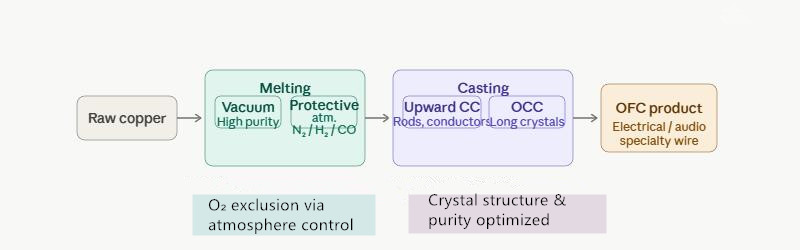
Producing oxygen-free copper requires strict control of oxygen throughout melting, casting, and processing operations.
Vacuum Melting
Vacuum melting completely isolates molten copper from atmospheric oxygen. This process produces extremely high-purity copper and is commonly used for premium-grade materials, although production costs are relatively high.
Protective Atmosphere Melting
Most industrial oxygen-free copper is produced using controlled atmospheres containing nitrogen, hydrogen, carbon monoxide, or other protective gases.
These atmospheres prevent oxidation while reducing existing copper oxides during the melting process.
Upward Continuous Casting
Upward continuous casting has become one of the most widely used production methods for oxygen-free copper rods and conductors.
The process combines high productivity, excellent metallurgical quality, and consistent material properties, making it ideal for electrical conductor manufacturing.
OCC Continuous Casting
The Ohno Continuous Casting (OCC) process was developed in Japan to create extremely long crystal structures with very few grain boundaries.
OCC copper is commonly associated with high-end audio cables and specialty electronic applications where signal transmission quality is a primary concern.
Common Oxygen-Free Copper Grades
Several international standards define oxygen-free copper grades.
| Standard | Grade | Description |
| ASTM | C10100 | Oxygen-Free Electronic Copper (Cu-OFE) |
| ASTM | C10200 | Oxygen-Free Copper (Cu-OF) |
| ASTM | C11000 | Electrolytic Tough Pitch Copper (Cu-ETP) |
| EN | CW009A | Cu-OFE |
| EN | CW008A | Cu-OF |
| EN | CW004A | Cu-ETP |
| GB/T | TU1 | High-Purity Oxygen-Free Copper |
| GB/T | TU2 | Standard Oxygen-Free Copper |
Among these grades, C10100, C10200, and C11000 are the most frequently specified for conductor manufacturing.
Cu-OFE (C10100): The Highest Purity Commercial Copper
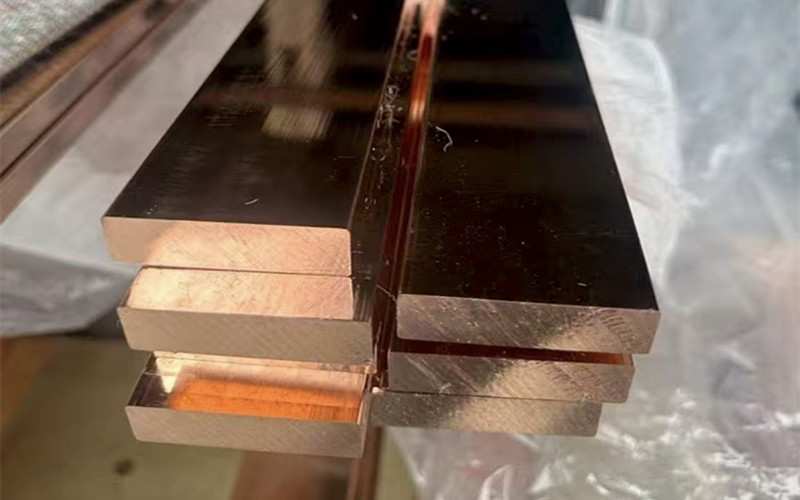
Cu-OFE (CW009A / C10100) is considered the highest-purity commercially available copper grade.
Typical Properties
Copper purity ≥ 99.99%
Oxygen content ≤ 5 ppm
Conductivity ≥ 101% IACS
Excellent thermal conductivity
Outstanding vacuum compatibility
Because of its extremely low impurity levels, Cu-OFE is widely used in applications where electrical performance and material stability are critical.
Typical Applications
1, Hollow Copper Conductors
Used in:
Semiconductor manufacturing equipment
Particle accelerators
Vacuum furnaces
High-frequency induction systems
2, RF and Microwave Conductors
Used in:
RF cavities
Microwave waveguides
Electron beam systems
High-frequency transmission equipment
3, Vacuum Conductors
Used in:
Vacuum interrupters
Ultra-high vacuum systems
Scientific research equipment
4, Aerospace Electrical Components
Used in:
Satellite power systems
Aerospace connectors
Mission-critical electrical assemblies
When conductivity, purity, and vacuum performance are the primary requirements, Cu-OFE is often the preferred material.
Cu-OF (C10200): A Practical Balance Between Performance and Cost
Cu-OF (CW008A / C10200) occupies the middle ground between Cu-OFE and Cu-ETP.
Typical Properties
Copper purity approximately 99.95%
Very low oxygen content
Conductivity around 100–101% IACS
Excellent resistance to hydrogen embrittlement
Although slightly less pure than Cu-OFE, it delivers many of the same benefits at a lower cost.
Typical Applications
1, High-Current Busbars
Used in:
Industrial power distribution systems
High-power switchgear
Electrical control equipment
2, Hollow Copper Conductors
Used in:
Water-cooled conductor systems
Induction heating equipment
Medium-frequency power systems
3, Induction Conductors
Used in:
Induction coils
Furnace power supplies
High-current heating equipment
4, Precision Connector Components
Used in:
Flexible connectors
Laminated conductors
Electrical contact assemblies
For many industrial applications, Cu-OF provides an excellent balance of conductivity, reliability, and cost efficiency.
Cu-ETP (C11000): The Industry Standard for Electrical Conductors
Cu-ETP (CW004A / C11000) remains the most widely used copper grade in the electrical industry.
Typical Properties
Copper purity ≥ 99.90%
Conductivity approximately 100% IACS
Contains oxygen
Excellent manufacturability
Cost-effective and widely available
Typical Applications
1, Copper Busbars
Used in:
Switchgear
Distribution panels
Electrical substations
Industrial power systems
2, Transformer Conductors
Used in:
Dry-type transformers
Oil-filled transformers
Transformer winding systems
3, Power Cables and Connectors
Used in:
Cable lugs
Electrical terminals
Connector systems
Flexible conductors
4, Motors and Generators
Used in:
Industrial motors
Generators
Electrical machinery
General power transmission equipment
For standard electrical applications, Cu-ETP continues to deliver excellent performance at the lowest material cost.
Limitations of Cu-ETP
Because it contains oxygen, Cu-ETP may be susceptible to hydrogen embrittlement under certain conditions, including:
High-temperature brazing
Hydrogen furnace exposure
Vacuum service environments
As a result, it is generally not recommended for ultra-high-vacuum systems, advanced brazed cooling assemblies, or high-purity electronic applications.
Cu-OFE vs Cu-OF vs Cu-ETP: What's the Difference?
After reviewing the characteristics of each copper grade individually, the next question is often straightforward: which material should you choose for your conductor application?
The answer depends on the required balance between conductivity, purity, manufacturing environment, long-term reliability, and cost.
The following table summarizes the key differences between Cu-OFE (C10100), Cu-OF (C10200), and Cu-ETP (C11000).
| Property | Cu-OFE (C10100) | Cu-OF (C10200) | Cu-ETP (C11000) |
|---|---|---|---|
| Copper Purity | ≥99.99% | ≥99.95% | ≥99.90% |
| Oxygen Content | ≤5 ppm | ≤10 ppm | 200–400 ppm |
| Conductivity | ≥101% IACS | ~100–101% IACS | ~100% IACS |
| Thermal Conductivity | Excellent | Excellent | Very Good |
| Vacuum Compatibility | Excellent | Very Good | Limited |
| Hydrogen Embrittlement Resistance | Excellent | Excellent | Moderate |
| Brazing Performance | Excellent | Excellent | Fair |
| High-Frequency Performance | Excellent | Very Good | Good |
| Availability | Limited | Good | Excellent |
| Relative Cost | Highest | Medium | Lowest |
Performance Comparison
For most industrial power applications, the conductivity difference between the three grades is relatively small. However, oxygen content becomes increasingly important when conductors are exposed to:
High temperatures
Hydrogen atmospheres
Vacuum environments
High-frequency electrical currents
Critical reliability requirements
In these situations, oxygen-free grades provide measurable advantages in long-term performance and durability.
Cost vs. Performance
From a cost-performance perspective:
Cu-ETP (C11000) is the standard choice for busbars, transformer conductors, motors, generators, and power cables.
Cu-OF (C10200) offers an excellent balance of reliability and cost for water-cooled conductors, induction systems, and high-current equipment.
Cu-OFE (C10100) is typically reserved for semiconductor equipment, RF systems, aerospace components, and ultra-high-vacuum applications where material purity is critical.
Which Copper Grade Should You Choose?
Material selection should always be based on operating conditions, performance requirements, and budget considerations.
Choose Cu-OFE (C10100) When:
Maximum conductivity is required
Vacuum compatibility is critical
RF or microwave performance matters
Semiconductor or aerospace applications are involved
Choose Cu-OF (C10200) When:
Oxygen-free copper is preferred
Improved reliability over ETP copper is required
Water-cooled conductors are used
High-current industrial systems are involved
Choose Cu-ETP (C11000) When:
Standard electrical applications are involved
Cost efficiency is the primary concern
Large-volume conductor production is required
General power distribution systems are being manufactured
Conclusion
While Cu-OFE, Cu-OF, and Cu-ETP all offer excellent electrical conductivity, their differences in oxygen content, purity, and performance characteristics make each grade suitable for specific applications.
Cu-ETP remains the most economical choice for conventional electrical conductors. Cu-OF provides improved reliability and oxygen-free performance for demanding industrial environments. Cu-OFE, meanwhile, represents the premium solution for semiconductor equipment, RF systems, vacuum technology, and other applications where maximum conductivity and material purity are essential.
Understanding these differences allows engineers and buyers to select the most appropriate copper grade, balancing performance, reliability, and cost for each conductor application.