Tinned Copper vs Bare Copper: Which one better?
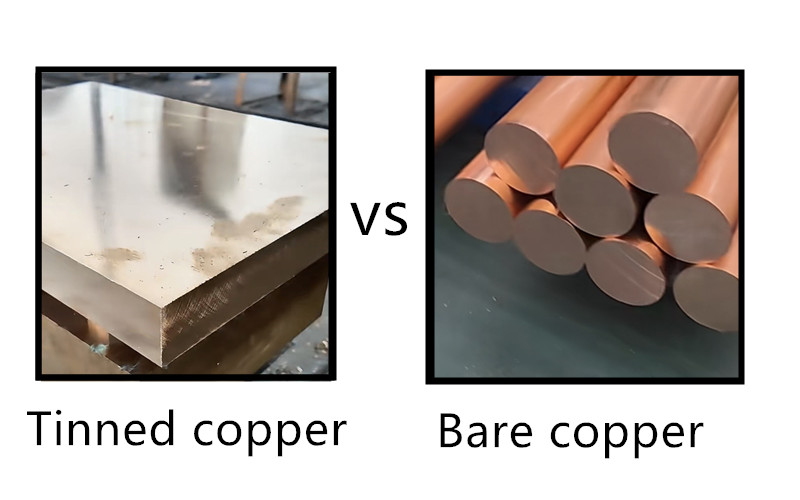
Tinned copper or bare copper materials all could be used for electrical and industrial applications, but which is better? Is tinned copper as good as pure copper? Well, the answer is not simple. We need consider the application environment, operating conditions, and the required service performance. In this article, we will break down the key differences to help guide the right choice.
What Is Tinned Copper?
Tinned copper is copper that is coated with a thin layer of tin on its surface. The base material remains copper, but the outer surface is covered with tin (Sn) through processes like hot-dipping or electroplating.
Electroplating deposits tin onto the copper surface using an electric current in a tin salt solution. This produces a thin, uniform coating — typically 1 to 20 μm — and is well suited for wire, foil, and strip products. After plating, a reflow process (heating above tin's melting point of 232°C) improves surface smoothness and adhesion.
Hot-dip tinning immerses the copper directly in molten tin at 280–320°C. The tin bonds to the copper through a metallurgical reaction, forming intermetallic compounds (Cu₃Sn, Cu₆Sn₅) at the interface. The resulting coating is thicker — typically 10 to 50 μm — with stronger mechanical bonding. This method is preferred for tinned copper busbar, tinned copper flat bar, and other industrial bar stock where coating durability matters more than dimensional precision.
Is Tin Conductive? What Happens to Conductivity After Tinning?
This is the first concern most engineers and buyers raise. Tin is a metal and is electrically conductive, but its conductivity is significantly lower than copper's — roughly 15% of copper's conductivity by volume.
However, in practice, the effect on a tinned copper conductor is negligible. The tin layer is extremely thin relative to the copper cross-section. The reduction in overall conductivity is less than 3%, which falls within acceptable tolerance for virtually all electrical applications. For tinned copper conductors used in cables, busbars, and terminals, the conductivity difference between tinned and bare copper is not a deciding factor.
What Are the Benefits of Tinned Copper?
Oxidation and Corrosion Resistance
Bare copper oxidizes readily when exposed to air and moisture, forming copper oxide on the surface. This oxide layer increases contact resistance and degrades performance over time. The tin coating acts as a barrier between the copper and the environment, significantly slowing oxidation.
In aggressive environments — marine, coastal, high-humidity industrial, or atmospheres containing sulfur dioxide or hydrogen sulfide — this protection becomes critical. Tinned copper conductors in these conditions retain stable electrical performance far longer than bare copper equivalents.
Solderability
Bare copper that has oxidized is difficult to solder. The oxide layer prevents proper wetting by solder, resulting in weak or inconsistent joints. Tin is a primary component of solder itself, so tinned copper surfaces remain solderable over extended storage periods. This is why tinned copper is the standard in PCB manufacturing, electronic component leads, and terminal connections where reliable soldering is required.
Contact Resistance Stability
In connectors, terminals, and busbars, the contact interface must maintain low resistance over the product's service life. Oxidation on bare copper surfaces causes contact resistance to rise gradually, leading to heat generation and eventual failure. A tin coating keeps the contact surface stable, extending reliable service life in switching equipment, distribution panels, and high-cycle connector applications.
Resistance to Sulfide Attack
Copper reacts with sulfur compounds found in vulcanized rubber insulation. Over time, this reaction corrodes the copper conductor and compromises the cable's mechanical and electrical integrity. Tinned copper isolates the conductor from the insulation material, preventing this reaction. This is one reason tinned copper wire has been the standard choice for rubber-insulated cables across marine and industrial applications for decades.
Tinned Copper Bar vs Bare Copper Bar
Tinned copper bars are copper bars coated with a thin layer of tin to improve corrosion resistance and solderability, especially in harsh environments.
Tinned Copper Bar Product
Tinned Copper Busbar
Used in switchgear, power distribution, and marine electrical systems.Tinned Copper Flat Bar
Used for grounding, electrical bonding, and long-life conductive connections.Tinned Copper Round Bar
Used in connectors, terminals, and precision electrical components.
Key Features:
Excellent corrosion resistance
Improved solderability
Stable long-term contact performance
Suitable for humid / marine / industrial environments
Bare copper bars are made of high-conductivity copper without any surface coating. They are widely used in electrical and industrial applications where maximum conductivity is required and the environment is controlled.
Bare Copper Bar Product
Bare Copper Busbar
Used in power distribution systems, switchgear, and electrical panels.Bare Copper Flat Bar
Used for grounding systems, short-circuit connections, and structural electrical bonding.Bare Copper Round Bar
Raw material for machining electrical connectors, terminals, and components.
Key Features:
Highest electrical conductivity
Easy to machine and fabricate
Cost-effective
Requires protection in corrosive environments
Tinned Copper vs Bare Copper Comparison Table
| Property | Bare Copper | Tinned Copper |
|---|---|---|
| Conductivity | Higher (baseline) | Within 3% of bare copper |
| Oxidation resistance | Poor | Good — tin layer acts as barrier |
| Solderability | Degrades with oxidation | Maintained long-term |
| Corrosion resistance (salt, humidity) | Low | High |
| Sulfide corrosion resistance | Low | High |
| Contact resistance over time | Increases | Stable |
| Cost | Lower | Higher (additional process) |
| High-temperature performance (>150°C sustained) | Stable | Risk of brittle intermetallic growth |
Tinned Copper vs Bare Copper Application
Bare Copper
Sealed or inert environments: No exposure to corrosive media, so tin coating is unnecessary
Cost-sensitive, high-conductivity applications: e.g., transformer windings and motor coils where bare copper is sufficient
Short-life or internally encapsulated products: copper is fully insulated and not exposed to air
High-temperature conditions (>150°C continuous): tin can form brittle intermetallic compounds (Cu₃Sn), which may degrade performance
Tinned Copper
Humid, salt-spray, or marine environments: corrosion protection is critical
Sulfur-containing rubber insulation systems: bare copper may corrode due to sulfur exposure
Applications requiring solderability: tin coating ensures reliable solder joints
Long-life connectors and busbars: stable contact resistance over time is essential
Food and medical-grade equipment: tin acts as a barrier to prevent copper ion migration
What is Tin Whiskers?
Pure tin plating may develop tin whiskers under long-term mechanical stress, which can cause electrical short circuits.
In high-reliability electronics, this risk is mitigated by:
Using tin-lead alloy plating, or
Applying post-reflow treatment on pure tin coatings
This is also one reason why bare copper is still preferred in some precision electronic applications.