Aluminum T temper Designations
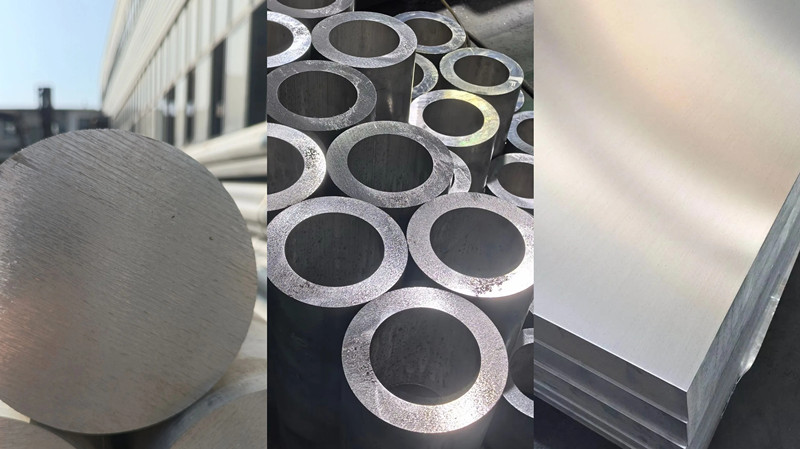
What is T temper about aluminum alloy ?
The T-temper system applies only to heat-treatable aluminum alloys (mainly 2xxx, 6xxx, and 7xxx series, plus some 4xxx and 8xxx).
2xxx series (Al-Cu) → 2024, 2219, 2618, 2214
6xxx series (Al-Mg-Si) → 6061, 6063, 6082, 6463
7xxx series (Al-Zn-Mg-Cu) → 7075, 7050, 7055, 7475, 7175
Other special alloys → some 4xxx (4032), 8xxx (8090 lithium alloys)
(1xxx, 3xxx, 5xxx are non-heat-treatable → they use O, H tempers, not T)
It is used across many product forms — Aluminum sheet, plate, bar, rod, pipe, tube, wire, and forgings.
Plate & Sheet → aerospace aluminum plate (2024-T4, 7075-T651, 7050-T7451)
Bar & Rod → extruded aluminum bar (6061-T6, 7075-T6511)
Pipe & Tube → drawn/structural aluminum tube (6061-T6, 2024-T3511, 7075-T73)
Extrusions (profiles) → 6063-T5/T6 window frames, 6463-T6 decorative trims
Forgings → aerospace aluminum forgings (7075-T7352 bar, 2618-T6)
Wire → 6061-T6 aluminum wire, 2024-T3 aluminum rivet wire
Why T-temper is used
1. T-tempers indicate solution heat treatment + aging.
2. Improves strength, hardness, fatigue resistance, stability.
3. Variants like T3, T4, T6, T73, T76 adjust toughness vs. stress-corrosion resistance.
TX Tempers
When a number from 0–10 is added after T, it indicates a subdivision of the T temper, called the TX temper. For example, T3–8.
The number after T corresponds to a basic sequence of heat treatment processes.
T0 Annealed temper. After cold working, the product is annealed to obtain the lowest strength, best ductility, and good workability. Mainly used for products requiring good forming performance.
T1 Cooled from an elevated-temperature shaping process (such as extrusion) and naturally aged to a stable condition. Applicable to products that do not require further cold working after shaping. Straightening is allowed.
T2 Cooled from an elevated-temperature shaping process, cold worked, and then naturally aged to a substantially stable condition. Applicable to products requiring certain strength and high dimensional stability.
T3 Solution heat treated, cold worked, and then naturally aged to a substantially stable condition. Applicable to products requiring good strength, high corrosion resistance, and dimensional stability. Straightening is allowed.
T4 Solution heat treated and naturally aged to a substantially stable condition. (Cold working is permitted: straightening is allowed, but it is not taken as part of the process). Commonly used for medium-strength products with high corrosion resistance.
T5 Cooled from an elevated-temperature shaping process and then artificially aged. Applicable to products that do not require solution heat treatment, yet need improved mechanical properties. Straightening is allowed.
T6 Solution heat treated and then artificially aged. The most widely used temper, with high strength and good mechanical properties. Straightening is allowed.
T7 Solution heat treated and then stabilized by over-aging. Provides dimensional stability, corrosion resistance, and stress-corrosion resistance. Used in aerospace and defense industries.
T8 Solution heat treated, cold worked, and then artificially aged. Used for products requiring high strength and fatigue resistance.
T9 Solution heat treated, artificially aged, and then cold worked. Used for products requiring very high strength and dimensional stability.
T10 Cooled from an elevated-temperature shaping process, cold worked, and then artificially aged. Applicable to extrusions and forgings requiring high strength.
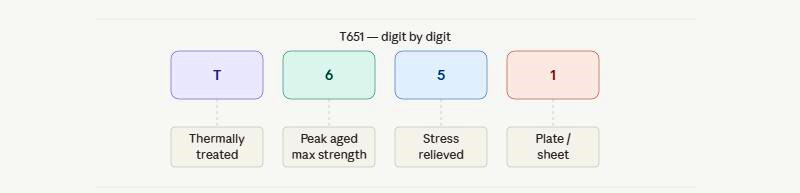
TXX Tempers and TXXX tempers
T42 Solution heat treated and naturally aged to a substantially stable condition (products are supplied in T4 temper, then processed into desired shapes, re-solution treated, and naturally aged).
T73 Solution heat treated and then over-aged (stabilized) to provide excellent stress-corrosion resistance, but with lower strength than T6. Commonly used in aerospace structures.
T74 Solution heat treated and then stabilized at a higher level of over-aging than T73. Provides good corrosion resistance and higher toughness.
T76 Solution heat treated and over-aged at a higher degree than T74, giving good resistance to exfoliation corrosion and stress corrosion cracking, but with reduced strength.
T77 Special artificial aging treatment applied after solution heat treatment, resulting in improved strength, toughness, and corrosion resistance compared with T6.
T79 Solution heat treated and subjected to special artificial aging to improve resistance to stress corrosion cracking and exfoliation corrosion.
T81 Solution heat treated, cold worked, then artificially aged (similar to T8 but with different processing).
T87 Solution heat treated, cold worked more heavily than T81, then artificially aged. Produces higher strength and hardness.
T351: Solution heat treated, stress-relieved by stretching. Common for 2xxx and 7xxx series aluminum plates. Provides a good balance of strength and dimensional stability.
T361: Solution heat treated and stress-relieved by stretching using special aerospace processes for improved dimensional stability.
T451: Solution heat treated, stress-relieved by controlled stretching, then naturally aged to a substantially stable condition.
T521: Solution heat treated, stress-relieved by stretching with enhanced dimensional stability, often used in precision components.
T531: Solution heat treated, stress-relieved by stretching, then naturally aged to a stable condition; provides good strength and stability.
T541: Solution heat treated, stress-relieved, then artificially aged to achieve high strength while maintaining corrosion resistance.
T651: Solution heat treated, artificially aged, then stress-relieved by stretching. Most common for 6061 and 6082 series. Offers high strength and good corrosion resistance.
T652: Solution heat treated, artificially aged, then stress-relieved by compressive stretching. Less common, used for specific dimensional requirements.
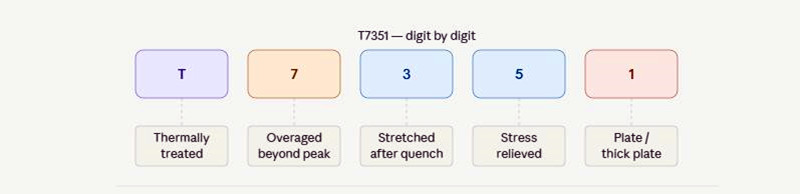
TXXX Tempers Stress-Relieved Tempers
TXX51 Used for rolled plates that have undergone solution heat treatment and then stress-relief stretching. The permanent elongation amount is 1.5%–3%. This temper improves machining dimensional stability. It is not suitable for products requiring sharp bends.
TXX510 Used for thick plates. After solution heat treatment, stress relief is achieved by compression (instead of stretching). Permanent compression deformation is about 1%–5%. This temper improves machining dimensional stability.
TXX52 Used for forgings that have undergone solution heat treatment and then stress-relief compression (not stretching). Permanent compression deformation is about 1%–5%. This temper improves machining dimensional stability.
TXX511 Used for extruded profiles and bars that have undergone solution heat treatment and then stress-relief stretching. Permanent tensile deformation is about 1%–3%. This temper improves machining dimensional stability.
TXX52 Used for forgings after solution heat treatment. Stress-relief compression deformation is about 1%–5%. Improves dimensional stability during machining.
TXX54 Used for die forgings that have undergone solution heat treatment. Stress relief is performed by cold working. Improves dimensional stability during machining.
This is explaining that tempers ending in 51, 52, 54, 510, 511 etc. are stress-relief tempers.
51 / 511 → stress-relief by stretching
52 / 510 → stress-relief by compression
54 → stress-relief by cold working
Except T temper, there are other tempers often met, like O, H, W etc, digging out all common tempers' meaning is useful and helpful for materials choosing, and could save you much cost and work.