Aluminum Busbar vs Copper in Power Distribution Cabinets
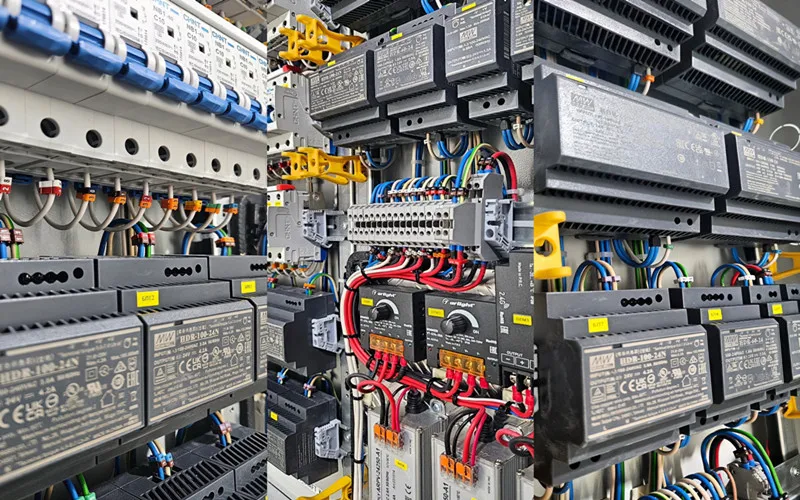
In low-voltage electrical distribution cabinets, switchgear, and other high-current power distribution equipment, aluminum busbars and copper busbars are two widely used options for electrical conductors. Copper has higher electrical conductivity, allowing a smaller cross-sectional area to carry a given current. Aluminum, on the other hand, has a much lower density, so a larger aluminum conductor can be used to achieve the required electrical performance while keeping the overall busbar system significantly lighter.
This difference makes the choice between an aluminum busbar and a copper busbar more complex than simply comparing electrical conductivity. Engineers and electrical equipment manufacturers need to consider current-carrying capacity, temperature rise, conductor dimensions, mechanical strength, weight, connection reliability, surface treatment, available cabinet space, and overall system cost.
So, why are aluminum bus bars widely used in electrical distribution cabinets if aluminum has lower conductivity than copper? And when does copper remain the better choice for a high-current distribution system? The answer depends on how the electrical and mechanical properties of each material affect the complete busbar system.
1. Conductivity and Weight: The Core Material Trade-Off
The fundamental difference between aluminum and copper busbars comes from two basic material properties: electrical conductivity and density. Copper has significantly higher electrical conductivity, while aluminum is much lighter.
Typical values for commercially used aluminum and copper are approximately:
| Property | Aluminum | Copper |
|---|---|---|
| Density | Approx. 2.70 g/cm³ | Approx. 8.96 g/cm³ |
| Electrical resistivity at 20°C | Approx. 0.028 Ω·mm²/m | Approx. 0.017 Ω·mm²/m |
| IACS conductivity | Approx. 61% | 100% |
| Relative weight | Approx. 30% of copper | 100% |
If two busbars have the same length and cross-sectional area, the copper busbar will have lower electrical resistance and therefore lower resistive losses at the same current. This gives copper an obvious advantage when cabinet space is limited and a compact conductor is required.
However, aluminum has a major advantage in density. Its density is only about 30% of copper, meaning that the same volume of aluminum weighs roughly one-third as much as copper. Even though an aluminum electrical busbar normally needs a larger cross-sectional area to compensate for its lower conductivity, the finished conductor can still be considerably lighter than an equivalent copper busbar.
This creates an important engineering trade-off: copper provides better conductivity per unit volume, while aluminum provides a strong conductivity-to-weight advantage. In applications where cabinet space is available for a larger conductor, reducing busbar weight can become a significant benefit.
This is one of the main reasons aluminum bus bars are used in electrical distribution cabinets, busway systems, and other high-current electrical applications. The goal is not necessarily to obtain the smallest possible conductor, but to achieve the required electrical performance with an acceptable combination of size, weight, cost, and mechanical characteristics.
2. How Much Larger Does an Aluminum Busbar Need to Be Than a Copper Busbar?
One of the first questions when replacing a copper busbar with an aluminum busbar is how much larger the aluminum conductor needs to be. A common theoretical approach is to compare electrical resistivity and increase the aluminum cross-sectional area to compensate for its lower conductivity.
The resistance of a conductor can be expressed as:
R = ρL/A
where R is electrical resistance, ρ is electrical resistivity, L is conductor length, and A is cross-sectional area.
If the aluminum and copper conductors have the same length and are designed to achieve similar electrical resistance, the larger resistivity of aluminum can be compensated for by increasing the cross-sectional area. For aluminum with approximately 60% IACS conductivity, the theoretical cross-sectional area may be around 1.6 times that of copper.
For example, a 50 × 10 mm copper busbar has a cross-sectional area of 500 mm². A simple resistance-based calculation would suggest an aluminum cross-section of approximately 800 mm² as a starting point.
However, this 1.6× figure should not be treated as a universal conversion rule for electrical distribution cabinets. Busbar design involves much more than DC resistance. The final aluminum busbar dimensions must also take into account allowable temperature rise, ambient temperature, heat dissipation, busbar arrangement, spacing between conductors, AC effects, short-circuit forces, mechanical stability, support spacing, and the available space inside the cabinet.
For this reason, replacing a copper busbar with aluminum should be treated as a system-level design change, rather than a simple cross-sectional-area calculation.
How Should the Additional Aluminum Cross-Section Be Arranged?
Once a larger cross-section is required, engineers can increase the width, thickness, or both. For example, a 50 × 10 mm copper busbar might be replaced by an aluminum busbar with a wider section such as 80 × 10 mm, or a thicker section such as 50 × 16 mm, depending on the cabinet layout.
Increasing the width may require additional horizontal space, while increasing thickness can affect bending, drilling, fastening, and other fabrication requirements. In some designs, the best solution is to optimize both dimensions according to the cabinet structure and thermal requirements.
For customized electrical applications, the choice of alloy, temper, dimensions, and fabrication method should therefore be considered together. Aluminum Bus Bars 6101 T65 T61 Customize can be used as an example of an electrical aluminum busbar solution where specific dimensions and material conditions need to be matched to the application.
3. Current-Carrying Capacity: Why Temperature Rise Matters
A common mistake when comparing aluminum busbars with copper busbars is to focus only on electrical resistance. In an actual electrical distribution cabinet, temperature rise is one of the most important factors affecting allowable current.
When current flows through a busbar, electrical resistance produces heat according to the relationship between current and resistance. Higher current and higher resistance increase heat generation, while the ability of the busbar to dissipate that heat depends on its surface area, surrounding air, installation position, and cabinet design.
For this reason, the current-carrying capacity of an aluminum busbar depends on more than its conductivity. Engineers may need to evaluate:
Busbar cross-sectional area
Current level
Ambient temperature
Surface area
Natural or forced ventilation
Busbar orientation
Spacing between adjacent conductors
Number of parallel busbars
Connection and joint temperature
AC skin and proximity effects
Short-circuit thermal and mechanical requirements
Increasing the cross-sectional area of an aluminum bus bar reduces electrical resistance, but it can also increase the surface area available for heat dissipation. Therefore, the actual current-carrying capacity must be verified under the intended installation conditions rather than calculated solely from the conductivity ratio between aluminum and copper.
A practical design process is to determine a suitable candidate cross-section based on the required current and then verify it against the allowable temperature rise, installation conditions, and applicable electrical standards.
4. How Aluminum Busbars Reduce the Weight of Power Distribution Cabinets
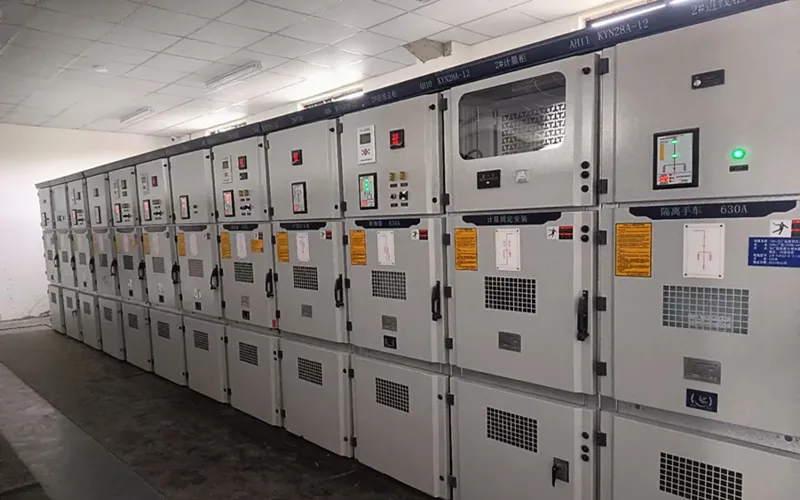
Weight reduction is one of the strongest practical advantages of aluminum busbars. The difference becomes particularly significant when a distribution cabinet contains multiple large busbars, long conductor runs, or high-current circuits.
Although an aluminum busbar generally requires a larger cross-sectional area than copper, aluminum's much lower density means that the final conductor can still be substantially lighter. This reduction in conductor weight can affect more than transportation and handling; it can also influence the mechanical structure of the electrical distribution cabinet.
Busbars are normally supported by insulators, clamps, brackets, cross members, and other mounting hardware. A lighter busbar places less static load on these components and can reduce the mechanical load transferred to the cabinet structure. For large switchgear assemblies and busbar systems, this can provide advantages during manufacturing, transportation, installation, and maintenance.
However, reducing weight does not mean that the mechanical design can be simplified without limits. Aluminum has a lower elastic modulus than copper, so its deflection behavior needs to be considered carefully, particularly when the busbar span is long.
Large-span aluminum busbars may require appropriate support spacing or a larger structural section to control deflection. The design should also consider short-circuit electrodynamic forces and vibration where applicable. In other words, the lightweight advantage of aluminum should be used to optimize the complete system rather than simply reducing material without checking mechanical stability.
5. Aluminum Oxide Film and Its Effect on Electrical Contact Resistance
Aluminum has another characteristic that needs special attention in electrical busbar applications: it rapidly forms a thin and dense oxide layer when exposed to air. Aluminum oxide has very high electrical resistivity and behaves essentially as an insulating material.
This does not mean that the aluminum busbar itself stops conducting electricity. The bulk aluminum remains electrically conductive. The concern arises at the contact interface between two conductors.
When two busbars or an aluminum busbar and a terminal are connected, current must pass through the contact area. If the interface contains contamination or an unsuitable oxide layer, the effective contact resistance can increase. Increased contact resistance can produce localized heating and may reduce the long-term reliability of the connection.
This distinction is important: the oxide film mainly creates a connection-interface problem rather than a bulk-conductivity problem.
Depending on the connection system, suitable surface preparation may include mechanical cleaning, controlled removal of surface contamination, or the use of an appropriate conductive joint compound. Tin plating and silver plating can also be used for specific electrical connection requirements.
Anodizing requires particular attention. An anodized aluminum surface contains a controlled oxide layer that is electrically insulating, so it should not normally be used as the direct conductive contact surface of a busbar joint. If an aluminum busbar requires anodizing for corrosion protection or appearance, the electrical contact areas must be designed separately.
6. Why Is Connecting Aluminum Busbars to Copper Terminals More Challenging?
In an electrical distribution cabinet, an aluminum busbar may need to connect to copper terminals, connectors, circuit breakers, or other copper components. This aluminum-to-copper interface requires more attention than a connection between components made from the same metal.
The first issue is the aluminum oxide film discussed above. The second is the possibility of galvanic corrosion. Aluminum and copper are different metals, and in the presence of moisture or an electrolyte, direct contact can create conditions for galvanic corrosion. This is particularly important in humid, coastal, salt-spray, or corrosive industrial environments.
A third consideration is aluminum's tendency toward creep and stress relaxation under long-term mechanical loading. The contact pressure created by a bolted joint may change over time, particularly when the connection is exposed to elevated temperatures or repeated thermal cycles.
Thermal expansion creates another difference between aluminum and copper. Because the two materials have different coefficients of thermal expansion, repeated heating and cooling can cause dimensional changes at the joint. Over a long service life, poorly designed connections may experience changes in contact pressure, fastener loosening, increased contact resistance, or localized heating.
For these reasons, an aluminum busbar should not simply be treated as a copper busbar with a different material. The connection system needs to be designed specifically for the properties of aluminum.
7. How Should Aluminum Busbars Be Connected to Copper Components?
A long-term electrical connection between bare aluminum and bare copper should not be designed without considering the interface materials, environmental conditions, and mechanical requirements.
One common solution is a copper-aluminum transition connector or terminal, which is specifically designed to provide a reliable interface between the two metals. Another approach for certain applications is tin-plating the aluminum busbar to improve the contact interface and compatibility with other electrical components.
The appropriate solution depends on the electrical system, operating environment, current level, connector design, and applicable standards. Large switchgear and distribution systems should use connection components and procedures that have been properly specified for aluminum conductors rather than simply copying the installation method used for copper busbars.
Mechanical installation is equally important. Connections should be assembled using the specified tightening torque and, where required, a calibrated torque wrench. Multi-bolt joints should be tightened according to the specified sequence so that contact pressure is distributed evenly. Appropriate washers, fasteners, joint compounds, and corrosion-protection measures should also be selected according to the connection design.
For copper busbar systems, the interface is generally more straightforward because copper-to-copper connections avoid many of the material-compatibility issues associated with aluminum-to-copper joints. For example, Oxygen-Free Copper Flat Bar may be considered when high conductivity and a copper-based connection system are preferred.
8. Which Aluminum Alloy Is Best for Electrical Busbars?
Not every aluminum alloy is equally suitable for use as a primary electrical busbar. Material selection needs to balance electrical conductivity, mechanical strength, creep resistance, extrusion performance, machinability, and operating conditions.
Four aluminum alloys that are often worth distinguishing are 1350, 6101, 6063, and 6061.
| Aluminum Alloy | Electrical Conductivity | Strength | Extrudability | Typical Application |
|---|---|---|---|---|
| 1350 | Very high | Relatively low | Good | High-conductivity electrical busbars |
| 6101 | High | Medium to high | Good | Electrical conductors and busbars |
| 6063 | Moderate | Medium | Excellent | Extruded electrical profiles |
| 6061 | Relatively low | High | Good | Structural and support components |
Actual mechanical and electrical properties depend on alloy temper, product dimensions, applicable standards, and manufacturing condition, so the final selection should always be based on the relevant material specification and certified data.
1350 Aluminum
1350 is a high-purity electrical aluminum alloy with very high electrical conductivity. It is suitable when electrical performance is the primary objective, but its relatively low mechanical strength means that long spans may require closer support or additional structural consideration.
6101 Aluminum
6101 is particularly interesting for electrical busbar applications because it provides a useful balance between electrical conductivity and mechanical performance. It offers good conductivity together with better strength and useful extrusion characteristics, making it suitable for electrical conductors and busbar applications where both current carrying and structural requirements need to be considered.
6063 Aluminum
6063 is well known for its excellent extrusion characteristics and ability to produce complex profiles with good surface quality. It can be useful for extruded electrical profiles where geometry, formability, and appearance are important. However, when maximum electrical conductivity is the primary requirement, dedicated electrical-conductor alloys may be more appropriate.
6061 Aluminum
6061 provides relatively high mechanical strength and is widely used for structural components, supports, frames, and machined parts. Its electrical conductivity is lower than that of dedicated electrical-conductor alloys, so high strength alone does not make 6061 the best choice for a primary high-current busbar.
The key principle is simple: the strongest aluminum alloy is not necessarily the best electrical busbar alloy. For a main conductive busbar, electrical conductivity and current-carrying performance must be evaluated together with the required mechanical properties.
9. Which Surface Treatment Should Be Used for Aluminum Busbars?
Surface treatment should be selected according to the function and location of the aluminum busbar. A treatment that improves corrosion resistance or provides electrical insulation may not be suitable for a conductive contact surface.
| Surface Condition / Treatment | Main Purpose | Direct Electrical Contact Surface |
|---|---|---|
| Bare aluminum | Conventional conductive busbars | Suitable when properly prepared |
| Tin plating | Improved contact and connection performance | Suitable for specific electrical connections |
| Silver plating | High-performance electrical connections | Suitable for specific applications |
| Painting / powder coating | Insulation and surface protection | Not suitable |
| Anodizing | Corrosion protection and appearance | Not suitable as a direct conductive surface |
For this reason, an aluminum busbar may need to be designed with separate electrical contact areas and protected non-contact areas.
Bare aluminum may be appropriate for conventional busbar applications when the contact surfaces are properly prepared according to the connection procedure. Tin plating can be useful where improved contact characteristics and compatibility with other electrical components are required. Silver plating is generally reserved for specific high-performance electrical applications.
Painting and powder coating provide protection or insulation but cannot be left between two surfaces that need to conduct current. The same principle applies to anodizing: the anodized layer should not remain between the conductive contact surfaces of a busbar joint.
10. Five Common Mistakes When Using Aluminum Busbars in Distribution Cabinets
Mistake 1: Simply Making the Aluminum Busbar 1.6 Times Larger Than the Copper Busbar
The 1.6× figure is only a theoretical resistance-based reference. Actual busbar dimensions must also be checked for temperature rise, heat dissipation, installation conditions, short-circuit forces, mechanical stability, and applicable standards.
Mistake 2: Using an Anodized Surface as a Direct Electrical Contact Surface
Anodizing creates an electrically insulating oxide layer. An anodized area should therefore not be treated as a normal conductive contact surface. Electrical contact areas need to be designed and prepared separately.
Mistake 3: Directly Bolting Bare Aluminum to Bare Copper
An aluminum-to-copper joint requires consideration of oxide films, galvanic corrosion, contact pressure, thermal expansion, and long-term environmental exposure. Appropriate transition connectors, plating, joint compounds, and connection procedures may be required.
Mistake 4: Assuming 6061 Is the Best Busbar Alloy Because It Has High Strength
Mechanical strength and electrical conductivity are different properties. A high-strength alloy such as 6061 may be useful for structural components, but the material for a primary conductive busbar should be selected based on the required combination of conductivity, current capacity, temperature rise, and mechanical performance.
Mistake 5: Tightening Bolts Without Torque Control
A reliable electrical joint requires controlled and uniform contact pressure. Over-tightening can damage components, while insufficient tightening can increase contact resistance. The specified torque for the particular connection system should therefore be followed rather than relying on hand feel.
11. Aluminum vs Copper Busbars: Which One Should You Choose?
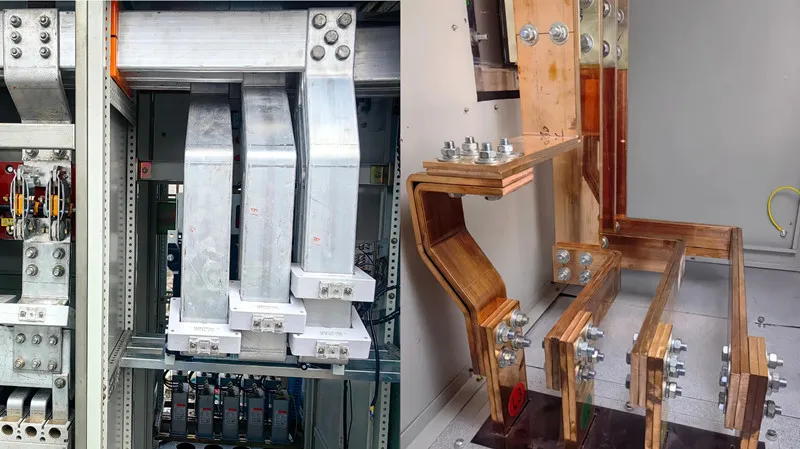
There is no universal answer to whether aluminum or copper is better for an electrical distribution cabinet. The appropriate choice depends on the electrical, mechanical, spatial, environmental, and economic requirements of the system.
When Aluminum Busbars May Be the Better Choice
Aluminum busbars are worth considering when:
Weight reduction is important
The cabinet has sufficient space for a larger conductor cross-section
Lower conductor weight is desirable
Long busbar runs are involved
Large quantities of conductor material are required
Transportation and handling weight are important
The aluminum-to-copper connections can be properly engineered
Temperature-rise and mechanical requirements can be satisfied
The combination of low density, good conductivity, and relatively easy fabrication makes aluminum particularly attractive when the design can accommodate a larger conductor cross-section.
When Copper Busbars May Still Be Preferable
Copper busbars may remain the better choice when:
Cabinet space is extremely limited
A smaller conductor cross-section is required
High current density is important
Electrical connections are highly compact
Maximum conductivity is a priority
The design requires a compact busbar arrangement
The system environment makes aluminum-to-copper connection management more difficult
For applications requiring a tinned copper conductor and a copper-based electrical connection system, Tinned Copper Busbar can be considered where the required electrical and surface characteristics match the application.
Ultimately, the choice should not be reduced to “aluminum is cheaper” or “copper is better.” Aluminum offers a combination of low weight, adequate electrical conductivity, and larger allowable conductor dimensions, while copper offers higher conductivity and more compact conductor geometry. The best choice is the material that meets the complete design requirements with acceptable electrical, mechanical, thermal, installation, and lifecycle costs.
Conclusion
Aluminum busbars and copper busbars each have a well-established role in electrical distribution cabinets. Copper has the advantage of higher electrical conductivity, which makes it particularly attractive when space is limited or a compact high-current conductor is required. Aluminum, however, has a much lower density, allowing engineers to use a larger cross-section while still achieving a substantial reduction in conductor weight.
The decision therefore goes far beyond comparing electrical conductivity. A properly designed aluminum busbar system needs to account for cross-sectional area, current-carrying capacity, temperature rise, mechanical support, oxide-film management, aluminum-to-copper connections, alloy selection, surface treatment, and installation torque.
For electrical distribution cabinet manufacturers and engineers, the most useful way to compare aluminum and copper is to consider the entire system rather than the conductor alone. Aluminum can provide significant advantages when weight, material efficiency, and available space are favorable, while copper remains highly competitive when compact dimensions, high conductivity, and straightforward electrical connections are the primary priorities.
In the end, choosing between an aluminum busbar and a copper busbar is not simply a matter of choosing the material with the highest conductivity. It is a matter of balancing electrical performance, conductor size, weight, mechanical stability, connection reliability, and total system cost for the specific distribution cabinet application.