What Is Clad Aluminum? A Complete Guide to Corrosion-Resistant and Brazing Cladding
In aluminum alloy procurement and technical material selection, “clad aluminum” is a term that comes up frequently but is rarely explained in a truly clear way. When buyers come across product names such as “7075 alclad sheet” or “4343-3003 clad sheet coil,” they often understand only that these are “aluminum sheets with a cladding layer,” without knowing what the cladding actually does or what the fundamental differences are between different types of clad products.
This article starts from the underlying principles and systematically breaks down the two major types of clad aluminum products, helping you quickly determine which type is actually suitable for your application.
1. What is “Clad” Aluminum?
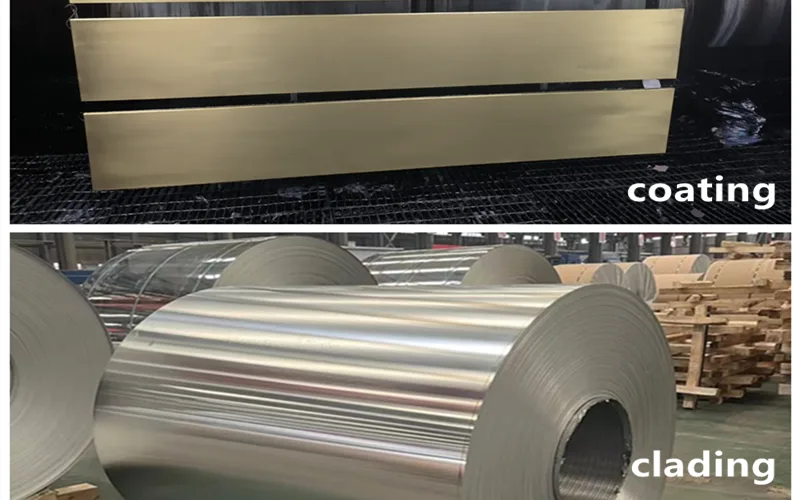
In the context of aluminum alloys, “clad” refers to two or more aluminum alloys with different compositions being bonded into a single laminated sheet through a hot roll bonding process, rather than simply applying a surface coating or mechanically attaching one material to another.
There is a very important distinction here, and it is also one of the most commonly misunderstood points:
Metallurgical bonding ≠ surface coating.
Processes such as anodizing, painting, and electroplating add a thin functional layer to the surface of an aluminum alloy. In essence, the layer is “attached” to the material surface. Clad aluminum sheet, by contrast, is produced by stacking two (or three) different aluminum alloy slabs together and subjecting them to high temperature and high pressure during rolling. This allows atomic diffusion to occur at the interface, ultimately forming an integral material with a bond strength approaching that of the base material itself.
The cladding layer is not simply “stuck” onto the core—it is essentially “grown into” the core through metallurgical bonding.
In this structure, the layer responsible for the main structural properties is generally referred to as the core, while the layer responsible for a specific function, such as corrosion resistance or brazing, is referred to as the clad.
Depending on how the cladding is arranged, clad aluminum can be divided into:
Single-side clad: The clad layer is applied to only one side, while the other side retains the original core surface.
Double-side clad: Both sides of the core are covered with clad layers, creating a structure that is more like a “sandwich.”
Once you understand this basic structure, an obvious question arises: if the cladding layer is not there for appearance, what exactly is it designed to solve?
That depends on the specific type of clad product.
2. Clad Aluminum Sheet vs. Ordinary Aluminum Sheet: What Is the Core Difference?
Bare aluminum sheet is rolled from a single alloy, meaning the properties of the entire sheet come from the composition and design of that one alloy. For example, 5083 relies primarily on magnesium to provide strength and seawater corrosion resistance, while 3003 relies primarily on manganese to provide formability and moderate strength. Its properties are therefore uniform throughout the material, with no additional functional layers.
Clad aluminum sheet, by contrast, follows a design philosophy in which two alloys perform different functions: the core provides the primary properties required from the material, such as high strength or good formability, while the clad provides a function that the core inherently lacks and cannot easily achieve through alloying alone, such as corrosion resistance or brazing capability.
In other words, the existence of clad aluminum essentially answers one question: Why not simply use one alloy?
| Comparison | Ordinary Aluminum Sheet (Bare Aluminum) | Clad Aluminum Sheet |
|---|---|---|
| Structure | Single alloy | Two or more alloy layers laminated together |
| Bonding method | No bonding required; inherently integral | Hot roll bonding, forming a metallurgical bond |
| Source of properties | Properties of a single alloy composition | Cooperative performance of Core + Clad |
| Typical examples | 3003, 5052, 6061 single-alloy sheet | 7075/2024 alclad, 6951-4104 brazing sheet |
| Problem solved | — | Functions the core cannot provide on its own, such as corrosion protection or brazing |
Take 7075 as an example. It is a high-strength aerospace structural alloy in the Al-Zn-Mg-Cu system and offers exceptional strength. However, its relatively high copper and zinc content makes it more susceptible to intergranular corrosion and exfoliation corrosion in humid or salt-spray environments.
If 7075 were expected to provide both high strength and high corrosion resistance solely through its own alloy composition, these requirements would be difficult to reconcile metallurgically. This is exactly where a clad layer becomes necessary.
Similarly, an alloy such as 3003 does not have the low-melting characteristics required for brazing and therefore cannot melt and fill a joint by itself. This is why an additional cladding layer is required.
This leads to two completely different technical directions for clad aluminum products.
3. The Two Major Types of Clad Aluminum Sheet
From the perspective of the cladding layer’s function, clad aluminum products on the market can be clearly divided into two major categories. Although both are called “clad,” the problems they solve, the material selection logic, and their ultimate applications are fundamentally different:
Corrosion-Resistant Clad — the cladding layer is designed to “sacrifice itself to protect the core.”
Brazing Clad — the cladding layer is designed to “melt and fill the joint.”
One type of cladding remains solid throughout service and works through electrochemical differences; the other has the opposite purpose, with its core value being its ability to melt and flow at a specific temperature.
Understanding this fundamental difference is the key to understanding the naming logic behind virtually all clad aluminum products.
4. Corrosion-Resistant Clad Aluminum
4.1 Working Principle: Sacrificial Anodic Protection
The fundamental principle behind corrosion-resistant cladding is sacrificial anodic protection.
The clad layer is made from an alloy with a more negative electrochemical potential than the core, making it more anodic. In humid, salt-spray, and other electrolyte environments, the clad layer preferentially corrodes, thereby protecting the core and preventing it from suffering more serious forms of corrosion such as intergranular corrosion or exfoliation corrosion.
This protective layer is necessary because high-strength aerospace structural alloys such as 7075 (Al-Zn-Mg-Cu) and 2024 (Al-Cu-Mg) contain relatively high levels of copper and zinc. These alloying elements provide excellent strength, but they also reduce the material’s inherent corrosion resistance.
The clad layer is typically made from commercially pure aluminum or a low-alloy aluminum alloy of the same material family. For example, 7075 is commonly clad with 7072, while 2024 is commonly clad with high-purity aluminum such as 1230.
The clad layer remains solid throughout the process and does not melt during thermal processing. Its sole purpose is to provide protection through the electrochemical potential difference between itself and the core.
4.2 Typical Products
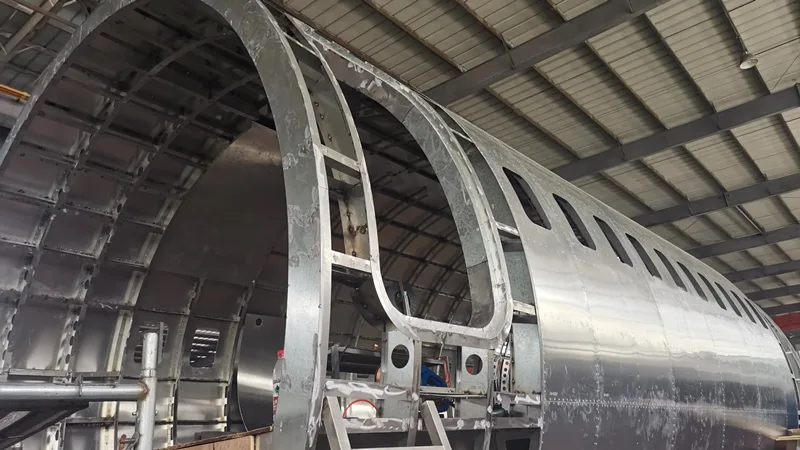
7075 Alclad Sheet: 7075 is one of the highest-strength aluminum alloys used for aerospace structural components, but its corrosion resistance is relatively limited. Alcladding significantly improves its corrosion resistance while retaining the high strength of the core, making it a common choice for aircraft skins and structural sheet materials.
2024 Clad Sheet: 2024 belongs to the Al-Cu-Mg system and is known for its excellent fatigue performance and damage tolerance. It is commonly used for aircraft fuselage skins, wing tension members, and other components subjected to long-term cyclic loading. Adding a high-purity aluminum cladding layer improves surface corrosion resistance while retaining the fatigue-performance advantages of the core alloy.
For a more detailed discussion of whether 7075 can be clad and how much the cladding process affects its strength, see our previous article Is 7075 Aluminum Be Clad?
4.3 Typical Applications
Corrosion-resistant clad aluminum sheet is used predominantly in the aerospace industry, including aircraft skins, fuselage structural sheet materials, and other structural components that require both high strength and high corrosion resistance.
5. Brazing Clad Aluminum
5.1 Working Principle: The Cladding Layer Is the Filler Metal
The logic behind brazing cladding is completely opposite to that of corrosion-resistant cladding—the clad layer is not intended to “protect” the core, but to “melt.”
Brazing cladding typically uses 4xxx-series aluminum-silicon alloys, such as 4343 and 4104. Their silicon content is generally around 7%–12%. The addition of silicon significantly lowers the alloy’s melting point, producing a low-melting microstructure close to the eutectic composition.
During a brazing process, such as controlled atmosphere brazing (CAB) or vacuum brazing, the entire component is heated to a specific temperature range. This temperature is higher than the melting point of the clad layer but lower than that of the core.
The clad layer therefore melts and flows into the joint gap, filling the joint and solidifying upon cooling, while the core remains solid and maintains the overall structural integrity without collapsing or undergoing excessive deformation.
In other words, the cladding layer itself serves as the filler metal. There is no need to separately apply brazing paste or add brazing wire.
This is one of the major process advantages of brazing clad sheet: it eliminates the need to add filler metal separately and is particularly well suited to high-volume, highly automated heat exchanger production lines.
5.2 Typical Products
6951-4104 Aluminum Clad Sheet: 6951 is a heat-treatable Al-Mg-Si alloy with higher strength than conventional 3003 and is commonly used where higher strength is required, such as in header tubes. The 4104 cladding provides brazing capability while also containing zinc, giving it a certain degree of sacrificial anodic corrosion protection. This makes it suitable for applications that require both brazed joints and resistance to corrosion from cooling media.
4104-3003-4104 Clad Sheet: 3003 serves as the core, offering good formability and moderate strength. Both sides are clad with 4104, creating a “sandwich” structure in which both surfaces can participate in brazing. This configuration is suitable for tubes where both sides require brazed connections, such as applications where the outer surface is brazed to fins while the inner surface needs to be formed and sealed.
4343-3003 Clad Sheet Coil: This is a single-side clad structure. 4343 is a relatively straightforward Al-Si brazing alloy without additional corrosion-protection elements. Its sole function is to melt and flow to form the brazed joint. It is suitable for applications where brazing is required on only one side, such as fin stock.
5.3 Single-Side Clad vs. Double-Side Clad: How Do You Choose?
A comparison of 4104-3003-4104 and 4343-3003 shows that the selection logic is actually quite straightforward:
| Comparison | 4104-3003-4104 (Double-Side Clad) | 4343-3003 (Single-Side Clad) |
| Clad location | Cladding on both sides of the core | Cladding on one side of the core |
| Corrosion protection | Yes (4104 contains Zn) | No (4343 is a straightforward Al-Si brazing alloy) |
| Typical applications | Tubes requiring brazing on both sides, or applications where the inner wall contacts cooling media | Fin stock and single-sided components requiring brazing |
| Selection basis | Whether both surfaces of the component need to form brazed joints | Only one surface requires brazing while the other does not |
Simply put, first ask yourself:
“How many surfaces of this component need to participate in brazing, and does it also require additional corrosion protection?”
The answer will essentially determine whether you need a single-side or double-side clad product, and whether a zinc-containing alloy such as 4104 is required.
5.4 Typical Applications
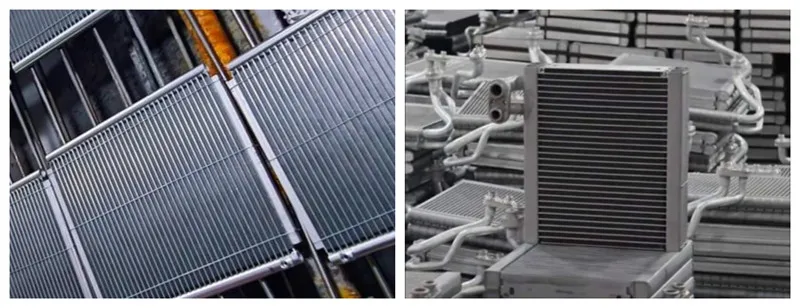
Brazing clad aluminum is concentrated primarily in heat exchanger applications, including automotive radiators, condensers, evaporators, and various HVAC heat exchanger tubes and fin stock.
Essentially, these are specialized sheet materials with “built-in brazing filler metal,” making them suitable for the mass production of brazed heat exchanger assemblies.
6. Production Process Comparison: Is the Underlying Logic the Same?
This is a question that is frequently asked but rarely explained in sufficient detail:
Since corrosion-resistant cladding and brazing cladding have completely opposite functional purposes, are their manufacturing processes also completely different?
The answer is: the underlying process logic is the same. Both use hot roll bonding.
The general process is as follows:
Cast clad ingot and core ingot → Surface preparation (milling, cleaning, and removal of the oxide film; this step directly determines whether solid-state diffusion bonding can be achieved) → Stack-up assembly (core and clad layers are stacked in a single-side or double-side configuration) → Hot rolling (plastic deformation under high temperature and high pressure allows the clean metal interfaces to form atomic-scale diffusion bonds, creating a metallurgical bond rather than a mechanical attachment) → Cold rolling to the final thickness → Annealing and tempering.
The process itself does not distinguish between the intended applications. Whether the final product is designed for corrosion protection or brazing, the physical mechanism of achieving diffusion bonding through surface cleanliness, deformation, and temperature is essentially the same.
The real differences lie in the alloy selection and clad ratio design, which are based on different functional objectives:
| Comparison | Corrosion-Resistant Clad | Brazing Clad |
| Function of cladding | Sacrificial anodic protection | Melting and filling the joint |
| Material selection basis | Electrochemical potential (clad has a more negative potential than the core) | Melting point and flowability (silicon content determines the melting-temperature window) |
| Typical cladding thickness | Usually thinner (approximately 2.5%–10% per side) | Can be thicker; with double-side cladding, each side must provide sufficient molten metal to fill the joint |
| Typical alloy systems | 7xxx/2xxx core + commercially pure aluminum or low-alloy clad | 3xxx/6xxx core + 4xxx (Al-Si) clad |
| Main applications | Aerospace structural components | Heat exchanger tubes and fin stock |
7. How to Choose the Right Clad Aluminum Sheet for Your Application?
When selecting a clad aluminum product for a specific application, you can follow the simple decision path below.
Step 1: Determine whether you need to solve a “corrosion problem” or a “brazing assembly problem.”
If your component will be exposed to humid, salt-spray, or other corrosive environments for extended periods while also requiring relatively high strength → you need corrosion-resistant cladding (7075/2024 alclad).
If your component needs to be assembled using a brazing process, such as joining heat exchanger tubes to fins → you need brazing cladding (6951-4104, 4104-3003-4104, or 4343-3003).
Step 2: Within brazing clad products, further determine the number of surfaces requiring connection and whether additional corrosion protection is needed.
Only one surface requires brazing → choose a single-side clad product, such as 4343-3003.
Both surfaces require brazing, or the inner wall will contact cooling media and requires additional corrosion protection → choose a double-side clad product such as 4104-3003-4104, or select a zinc-containing cladding such as 6951-4104.
Frequently Asked Questions (FAQ)
Q: Is clad aluminum sheet stronger than ordinary aluminum sheet?
Not necessarily. The strength of the core determines the main mechanical properties of the overall material. Adding a cladding layer generally does not significantly increase strength. In fact, because the cladding occupies part of the cross-sectional area, it may slightly dilute the high-strength characteristics of the core itself.
The value of clad aluminum is not that it is “stronger,” but that it “fills in a function that the core itself lacks.”
Q: Can clad aluminum sheet be welded using conventional welding methods such as TIG or MIG?
This requires an important distinction.
For brazing clad sheet, the cladding layer itself is the pre-installed brazing filler metal and is specifically designed to work with brazing processes such as controlled atmosphere brazing (CAB). This is completely different from conventional TIG/MIG fusion welding and the two process routes should not be confused.
For corrosion-resistant clad sheet, such as 7075/2024 alclad, weldability primarily depends on the welding characteristics of the core alloy itself and is not determined by the cladding layer.
Q: Is the choice between single-side and double-side cladding simply a matter of appearance?
No.
As discussed above, the selection is based on function—whether protection is required on one or both surfaces in a corrosion-resistant application, or whether one or both surfaces need to form brazed joints in a brazing application.
It is not simply a matter of appearance or cost.